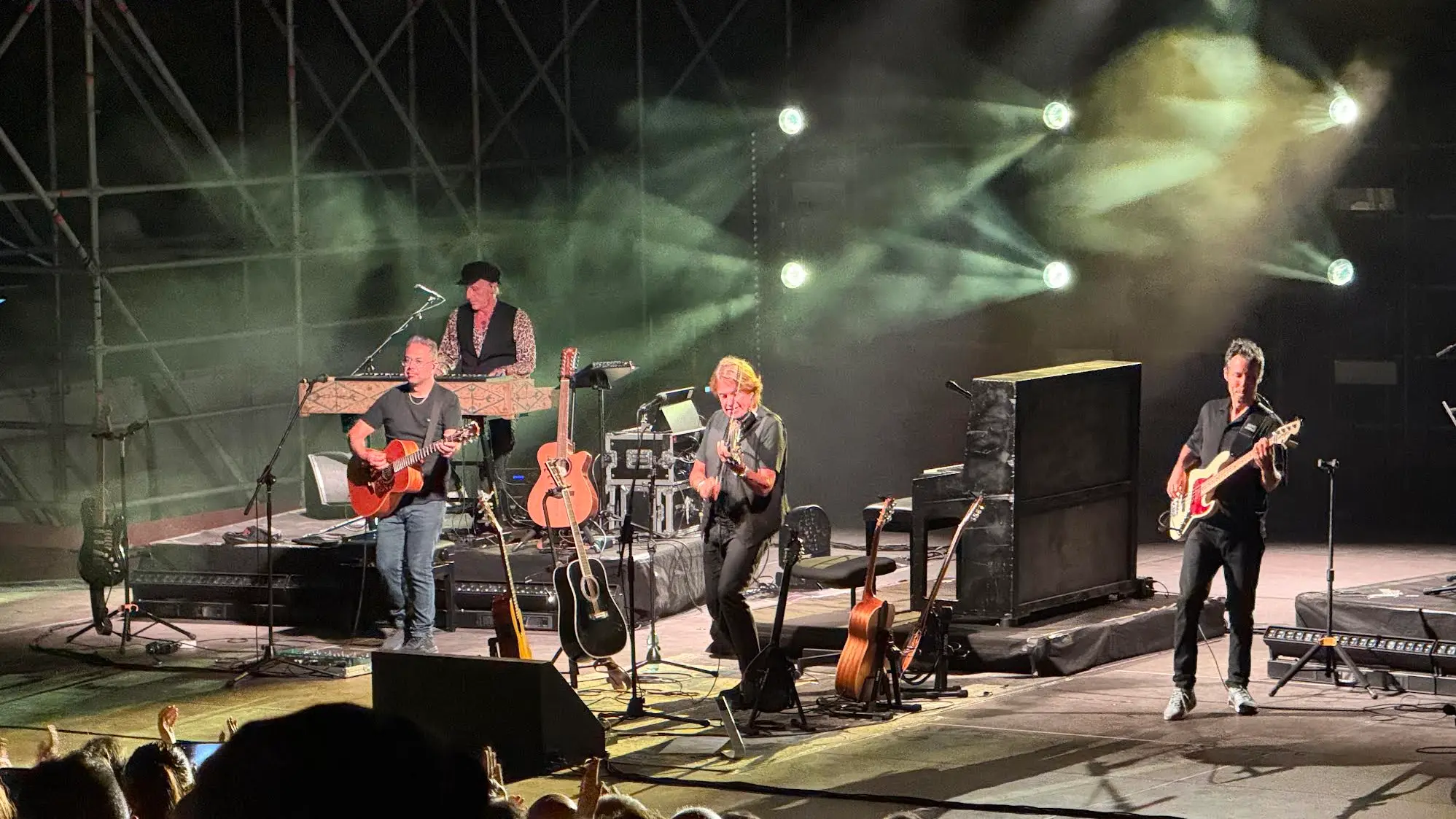


Everyone stood up and danced: the famous song "Il pescatore" got the audience dancing, filling the Tharros theater. Cristiano De André was the star of one of the most anticipated events of the "Giants of Art 2026" festival.
A remarkable display of musical quality, restoring the depth of Fabrizio De André's poetic universe with rigor and personal sensitivity.The concert opened with "Mega Megun" and "A Cimma," introducing the audience to a journey through some of the most significant pieces of Fabrizio De André's repertoire. This was followed by "Ho visto Nina volare," "Don Raffaè," "Se ti tagliassero a pezzetti," "Smisurata preghiera," and "Verranno a chiederti," in an opening section punctuated by moments of dialogue with the audience.Cristiano De André explored this musical heritage without limiting himself to mere recollections. His performances maintained the power of the lyrics and melodies intact, while also revealing a personal style, developed over years of engagement with his father's work. A coherent narrative emerged, in which family memories and artistic legacy converged without overlapping.
The artist emphasized his deep connection to Sardinia, the land he has chosen to live in. He shared anecdotes about Fabrizio and the last tour they undertook together, recalling how his father had entrusted him with an increasingly important role over time, placing growing trust in him . He recalled his father's belief that there were no good powers and his rejection of violence, emphasizing that any change must begin with everyday relationships, starting "with the neighbor."The journey continued with La canzone del padre, Nella mia ora di libertà, Bocca di Rosa, Amico fragile, Marinella, and Coda di lupo. These songs, different in style and mood, are united by their ability to describe marginalized figures, conflicts, feelings, and desires for freedom.