









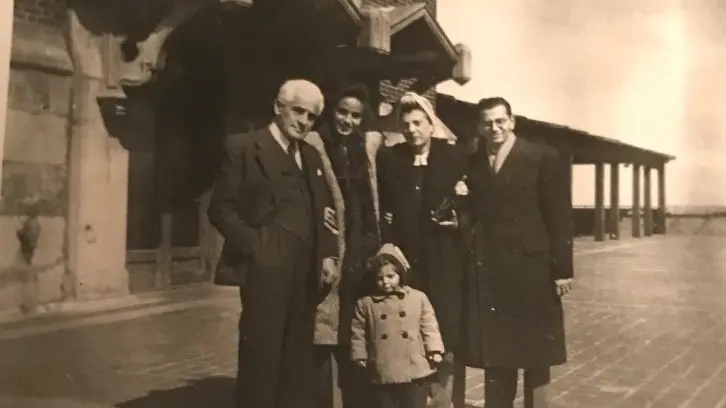











Recently the story of Professor Teodoro Levi, extraordinary of Archeology at the University of Cagliari and great teacher of as many great intellectuals and custodians of our archaeological heritage, starting with Giovanni Lilliu, who was forced to leave the capital and Italy which has become hostile territory for Jews to find refuge in New York.
The hope is that the Municipality of Cagliari will know, in recent weeks, well remember events like this, giving Doro Levi the right position in the historical memory of the city.
Among the many events, perhaps unknown to the most unknown, and on which even in these cases the feeling of "damnatio memoriae" is prevalent, there is another that finds a collateral connection with that of Professor Levi: that of Renato Salinas.
In the State Archives of Cagliari, in the rich collection of the Police Headquarters-Prefecture which goes from 1938 to 1943 and entitled "Jews", which is certainly the rich documentary base from which to start any research that aims to reconstruct the events of the Jews in Sardinia during the years of persecution, in the year 1941, with the date of 19 December, a letter sent to the Prefecture of Cagliari by the Police Headquarters appears, in which it is indicated that “the Jew Salinas dott. Renato di Giuseppe and Levi Olga, born in Cairo in Egypt on 7-9-1905 and residing in Cagliari, viale Regina Margherita 16, adjunct architect at the local Superintendency of Antiquities and Fine Arts, in January 1939 he left this city heading for in Rome, from Rome he went to London and then to Shanghai. This information was provided by the local Superintendent director who learned them from friends of Salinas who received postcards illustrated by the said individual ".
The character spoken of in this document is precisely Renato Salinas, whose story is truly emblematic and incredible.

THE GHETTO OF SHANGHAI - Salinas was an architect who was in service since January 1938 in Cagliari as an adjunct to the Royal Superintendency of the works of art of antiquity of Sardinia (following the passing of the competition and with an oath taken in the hands of Teodoro Levi), and his "escape" from Cagliari to Shanghai is due to the events of China and the numerous Jews who converged, at the end of the 1930s, in this city, which seemed to be truly the only place where they could still be saved from persecution . However, Shanghai was under Japanese occupation since 1937 and, in the city of Shanghai where many Jewish refugees, especially from Eastern Europe, converged year after year, the Japanese authorities established in 1937 a residential neighborhood for Jews, called by some historians "The ghetto of Shanghai ".
It was a neighborhood not comparable to the Nazi ghettos like that of Warsaw, no one from Shanghai was deported to the death camps. The pro-Nazi Japanese authorities never handed the Jews over to the Nazis despite being repeatedly requested, and this was also thanks to the ruse of Shimon Sholom Kalish, rabbi interned in the Shanghai Ghetto who convinced the Japanese military governor that the Jewish people were so hated by the Nazis in as "of oriental origin".
However, various historical documents agree on the precarious living conditions in this neighborhood, especially following the entry into the war of the United States in 1941, when the dispatches of various humanitarian aid arriving from the United States through the Jewish World Congress were suppressed in the ghetto. . American Jewish Join American Distribution comittee (JDC) representative Laura Margolis, who arrived in Shanghai, attempted to stabilize the situation by obtaining permission from the Japanese authorities to continue her fundraising activity, turning for help to Russian Jews who had arrived before the 1937 and were exempted from the new restrictions. The Shanghai ghetto was liberated by Chiang Kai Shek's Chinese Liberation Army on September 3, 1945.

INTERNATION - However, in relation to Renato Salinas, his story assumes, with a cross between his own testimony, released in an impersonal way after his return to Italy in 1948, and the documentation collected by other historians in the research on the matter to Jewish refugees and civilians deported to China between 1939 and 1945, a further, sadly worse, development. Renato Salinas, in fact, was interned for three years in the Japanese concentration camp of Weihsien (Wexen), a town located in the province of Shandong, in China, operational from March 1943 to October 1945 and which saw the internment of over 2200 civilian internees from: Russia, China, America, Great Britain, Belgium, Holland, Italy. The camp was liberated by the Americans on August 17, 1945.
From the internment file of Renato Salinas, now available in the online database of civil internment in China by the Japanese army, it is clear that at the time Renato Salinas was employed at the company ED Sassoon & Co. An Anglo-Indian company . During the same period, other people from the Salinas family were also interned: Armando Salinas, 32, Eve Salinas, 24 (Armando's wife) and their 2-year-old daughter Liliana. This is Renato's brother, who was also present in Shanghai during the years of the Shoah. Analyzing further documentation, this time kept by the same Salinas family in Ottawa, Canada, it turns out that Armando with his whole family, and so too Renato, were in Shanghai but, thanks to the maintenance of their Italian citizenship, they were able to stay out of the Shanghai ghetto district. This, however, had not happened to the rest of the family of his brother Renato's wife, locked up in the "ghetto" for foreigners in the city. They were arrested in October 1943 by the Japanese as belonging to a nationality that was now an enemy of the axis and then deported to Weihsien. After the liberation, Armando with his wife and child remained in China for three more years, and then escaped from the Communist dictatorship of this country to reach Ottawa, Canada, in 1948.

THE RETURN - Renato, on the other hand, returned to Italy, but he spoke little of those experiences and especially of the two years in a Japanese concentration camp, an experience that he always said was very painful. We can only imagine the trauma of escaping from an anti-Semitic persecution in a place and then finding himself interned in a concentration camp by an army collaborating with the axis in the conflict, certainly not as a Jew, but as a citizen of a former ally country that had removed him. from social and professional life as a "second-class citizen": a sort of incredible mockery of history.
At his death, which occurred about twenty years ago, few people were present.
It is necessary for the Municipality of Cagliari to remember all these people and all these events, perhaps with a plaque or a stumbling block in front of their old addresses. Even the most recent teaching of the Shoah insists a lot on the duty to start from the local and then arrive at national and European history, to create that empathy that makes us aware of how much this is "our" history.
Alessandro Matta
(director of the Sardinian Shoah Memorial Association)