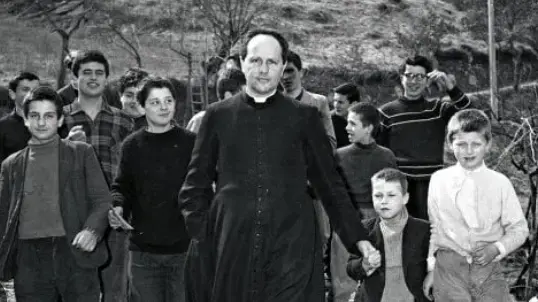


«I learned that other people's problems are the same as mine. Coming out of it all together is politics. Coming out of it alone is greed." Lorenzo Milani says so. His words and his action are always revolutionary, even today, one hundred years after his birth. To the presbyter to whom the human and cultural experience of the Barbiana school is linked, Alberto Melloni , professor of History of Christianity at the University of Modena and Reggio Emilia and academic of the Lincei, dedicated "Storia di μ - Lorenzino don Milani" ( Marietti1820, 199 pages). A loved and discussed figure is the center of attention. It is not the first time that Melloni analyzes the many aspects of the Florentine educator's life.
Who is Don Milani?
«He has long been used in polemics as a sort of passepartout to say what the school should or should not do, both as a scapegoat as if he had been the one who made the school lose the authoritarian character that many still regret. He is a very particular figure to include in his time. He is a converted Jew, who survived the racial laws because his mother, ingeniously, decided to have a Christian marriage and have her children baptized in unsuspecting times. Once he became a Christian, he was overcome by a very strong evangelical anxiety. His lesson is that of being in a time different from ours and of being able to tell us things that concern the strength and truth with which each of us is called to live our own human and social experience."
With his ideas he changed schools and the world of education forever.
«For the school, Don Milani's experience is almost a paradox. His is a private school, run by a priest in a fairly authoritarian manner, which has become the paradigm of an open public school capable of redeeming social classes. Don Milani understood, in his time, both in front of the workers of Calenzano and in front of the farmers of Barbiana, that there is a silent and profound injustice that runs through Italian society. An injustice that concerns the word. The possession of the word, with the possibility of communicating, expressing oneself, understanding and understanding one another, is the truest form of citizenship. He is convinced that without the delivery of this word, which constitutes a humanizing gesture, nothing else, even evangelization, can have meaning. He asks the school to deliver the word to those who need it. All this had a strong impact on Italian society that has not disappeared. Don Milani broke the dogma that social destiny was handed down from generation to generation as an inevitable fact. With him the idea took root that there could be a social ladder capable of rewarding true merit. Ours is a different historical time, but I think that his ideas, in this respect, are still very current."