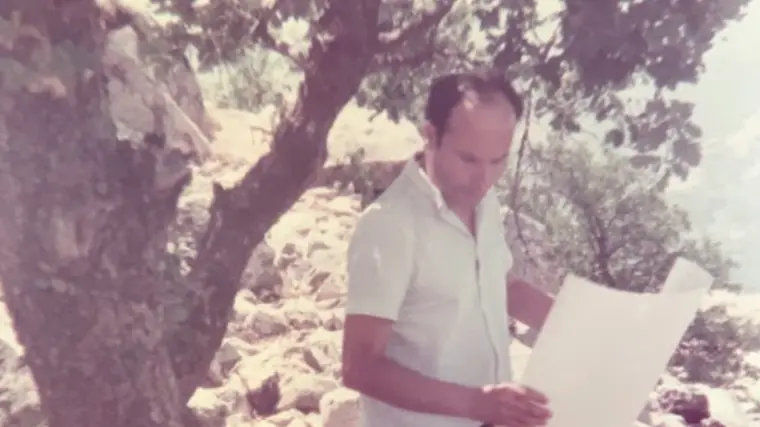


Starting from September 25th, the Man museum in Nuoro will pay homage to the artist Luigi Mazzarelli, 20 years after his death and more than 40 years since his last exhibition in an Italian public institution.
The White Book, written in the late 1980s, will be exhibited for the first time. After 1993—the year of the premature death of his daughter Ada, to whom the book is dedicated—Mazzarelli devoted himself fully to this project, the culmination of his long research in the art world. The exhibition is curated by Chiara Gatti, based on an idea by Elisabetta Masala. Alessandro Biggio will be a visiting artist. Coordination is by Rita Moro.
Luigi Mazzarelli, a truly multifaceted artist, should be remembered for the unconventional mark he left on the Sardinian cultural landscape. Born in Cagliari in 1940, he lived his intense human and cultural experience in the capital city. He began his career in the mid-1950s in Foiso Fois's studio. From his master, he received many valuable lessons on drawing and painting techniques. He cultivated his communist faith during years of struggle and revolutionary utopias. Art and politics go hand in hand, holding the red flag high.
Mazzarelli is one of the signatories of the manifesto of the Initiative Group, an association that brings together painters, writers, and intellectuals convinced that culture can be a powerful tool for changing the world.
In 1970, his interest in political activism, to which he wanted to dedicate himself fully, prevailed. In his studio on Via Santa Croce, he burned all the works he had produced over a fifteen-year career. Four years later, he returned to art. "Research," wrote Enrico Piras and Alessandro Sau, who rediscovered Luigi Mazzarelli's work, "cannot help but begin with the basic elements of the language: the artist uses watercolor as his preferred medium to explore the relationship between chiaroscuro. The starting point is the moment of rupture with which the avant-garde movements asserted themselves: the dissolution of the relationship between figure and background in the pictorial image, initiated in the Cubist works of Picasso and Braque, systematized in Gris's interpenetrations."