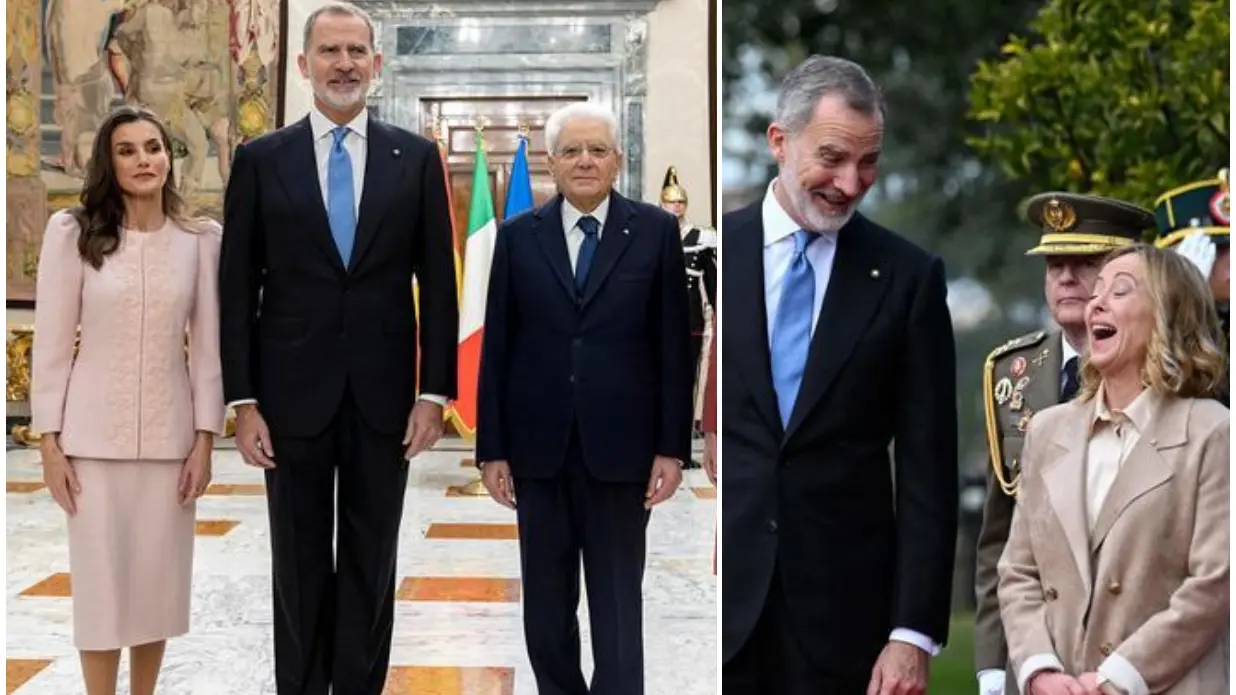


A speech that was never formal, with a progressive tone that one would not have expected from a monarch, albeit a constitutional one . A solemn speech to the Italian Parliament , decidedly political, with which King Felipe VI addressed all the hottest issues of European politics starting from a public recognition of the authority of the President of the Republic: I want to thank him, he immediately began, speaking in Italian, "for his sensitivity towards Spain, for always finding advice in the President of the Republic. You know it better than me, he is a point of reference for Italy and Italians, as well as for many heads of state, including me."
The ceremony at Montecitorio was the central moment of the state visit of the sovereign who was accompanied in all his appointments by his wife Letizia . And if the king impressed with the clarity of his positions, from Europe to NATO, his wife stole the attention of citizens and the media : her elegance - amplified by several changes of clothes in a few hours - was immortalized by photographers with hundreds of shots seen and reviewed on social media. Moreover, the historic Italian-Spanish sympathy had been well interpreted since the morning by Mattarella himself who had spoken of "extraordinary" bilateral relations. A concept immediately reciprocated by the king who, even more so like his father Juan Carlos, has a weakness for Italy: " Coming on a state visit to Italy is something very special, it is not just any visit, our countries - he underlined - have intense relations and are very good friends".
The great political harmony between Mattarella and the king was immediately evident. If the head of state defined the need for profound reforms for European institutions as "inevitable", the sovereign mirrored him in the Chamber by confirming the iron Euro-Atlantic vision of Rome and Madrid, explaining to parliamentarians that "the new Commission must orient the Union towards the future, guarantee global competitiveness and bet on a new internal market". But not only that. After quoting De Gasperi ("the future can only be built with the methodical application of the democratic method"), . He then closed with a reference to the : "We are two countries that have a clear awareness of the past, in particular of the fact that there is a past that must not and cannot be repeated, not even as a joke".