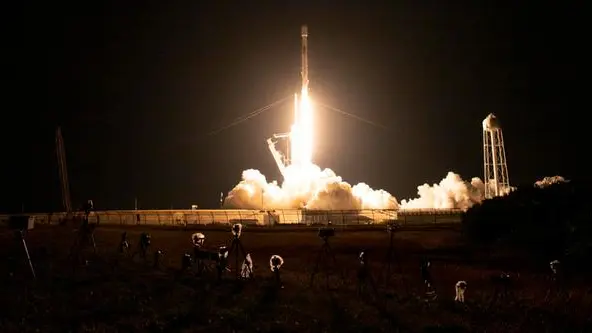


At seven this morning, from Cape Canaveral, the launch of the IXPE satellite telescope took place, born from the collaboration between NASA and an Italian partnership under the coordination of ASI, the Italian space agency, and with the scientific contribution of the National Institute of Astrophysics. A fundamental role was played by a team of researchers from the INAF-Astronomical Observatory of Cagliari both in the technological development of on-board instruments and in the development of observational and scientific procedures. For the first time, the Sardinian Observatory is directly participating in an international space mission of this magnitude.
IXPE, acronym for Imaging X-ray Polarimetry Explorer, is the name given to the NASA mission that brought a new telescope into orbit aboard a Falcon-9 from the American company SpaceX. The fundamental novelty is the measurement of the polarization of X-rays coming from some types of highly energetic cosmic objects such as supermassive black holes at the center of galaxies (billions of times the mass of the Sun) or tiny and very heavy neutron stars (the mass of Sun in just 20 km in diameter).
Italy provided the "heart" of the scientific mission: the detectors capable of recognizing the polarization of the X-rays of celestial objects that the satellite will observe during its 3 years of expected nominal life. In total, the Italian team is close to one hundred people and of these thirty - including the scientific manager Paolo Soffitta - are Inaf personnel and, in particular, four represent the INAF team from Cagliari: Alessio Trois, Matteo Bachetti, Maura Pilia and Andrea Possenti.
Trois, researcher technologist from Cagliari trained in the space astrophysics institutes of Milan and Rome before moving to Cagliari, explains: "The delivery of the Ixpe instrument to American colleagues in such a short time, just 3 years, was a success made possible only thanks to to the extraordinary organizational synergy of all the institutions involved. As Inaf of Cagliari we have made a substantial contribution in defining the logic of the on-board computer, in the integration and testing of the instrument as well as in its physical integration on the satellite module that will take it into orbit and in the qualification campaign of the entire observatory, consisting of by three identical and independent telescopes. We also take care of the support for the instrument's in-flight operations which will be managed directly by the American industry. "