









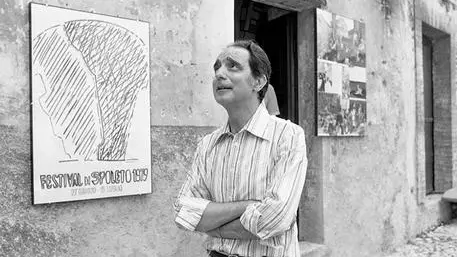











The dramatic period of the Resistance was a source of inspiration for numerous Italian writers who experienced its events firsthand. Among the main authors who dedicated their works to this difficult historical moment are Beppe Fenoglio (“Il partisan Johnny”, “A private question”), Elio Vittorini (“Uomini e non”), Cesare Pavese (“The house on the hill ”), Renata Viganò (“Agnese Goes to Die”).
In these novels the world of the Resistance is portrayed mostly without rhetorical tones, indeed with a certain harshness and realism that often brings them closer to documents of historical value rather than to real works of fiction. Within this group stands out the debut novel of an author best remembered for his "fantastic" novels such as "The Halved Viscount" (1952) and "The Baron in the Trees" (1957). We are talking, of course, about Italo Calvino and the book "The Path of the Spider's Nest", published in 1947, only two years after the end of the war. The book is part of the literary trend of Neorealism: written with a simple style and language, it narrates events that derive from the personal experience of the author, protagonist of the partisan struggle in those years. To adhere even more consistently to reality, Calvino uses popular terms and also makes use of dialectal forms, choosing to use the present tense as the verbal tense of the narrative, a solution that gives the story a more immediate and current rhythm.
In fact, Calvino sets his novel in Liguria, in Sanremo, in an alley of a working-class neighborhood: we are in the period following the armistice of 8 September 1943, therefore in the midst of the partisan struggle. The events are told from the point of view of a ten-year-old boy named Pin, motherless and with an absent father, who searches in vain for love and friendship in a harsh and often hostile environment.
After having lived the experience of prison, following the theft of a weapon which he had been forced to do by the adults in the alley, Pin ends up in the mountains with a group of partisans. Here he experiences dramatic events that leave a deep mark on him, he experiences fear, the violence of war and the bitterness of betrayal, until his sad return to the town that had suffered a roundup by the Nazis. More and more alone, he runs away again, and finally finds a friend in Cugino, the robust and gentle partisan who had taken him to the mountains, the only adult who shows him sincere affection and takes care of him.
Pin, the protagonist of the novel, appears suspended between two worlds that are too distant: that of adults and that of his peers. Of the former, among whom he lives, he adopts the language (often vulgar) and certain attitudes which are however not natural for a child of his age. Obviously, the adults do not consider him one of them, on the contrary, they make fun of him or try to use him for their own purposes, which are not always honest. In turn, precisely because of these behaviors, children see him as a stranger, preventing him from integrating with them.
The character thus lives with difficulty: he feels inadequate, and does not have a person in whom he can confide and on whom he can count in moments of confusion or crisis. He is unable to find a place in the world in which he lives as clarified by this passage, taken from the novel: "One would like to go with a band of companions, then, companions to whom he can explain the place where the spiders make their nests, or with whom have cane fights in the ditch. But the kids don't love Pin: he's the friend of the grown-ups, Pin, he knows how to say things to the grown-ups that make them laugh and get angry, not like them who don't understand anything when the grown-ups speak. Pin sometimes would like to get together with kids his age, ask them to let him play head and pile. But the boys leave him alone, and at a certain point they start beating him; because Pin has two thin little arms and is the weakest of all. And Pin has no choice but to take refuge in the world of grown-ups, grown-ups who also turn their backs on him, grown-ups who are also incomprehensible and distant for him as for the other kids, but who are easier to make fun of, with that desire of women and that fear of the police, until they get tired and start shoving him away."
However, there is a place where Pin feels happy and truly becomes a child again: it is the path of spiders' nests that gives the novel its title. This space hidden in the countryside is the only one where Pin is truly at ease, protected by a friendly and accomplice nature. It is a secret place, which only he knows and which he will talk about to Cousin once he is sure of his friendship and loyalty. It is the place of imagination and fantasy, an almost fairy-tale place, far from the harsh reality of war and a world that appears insensitive to the needs of a child. A further characteristic of this work is the choice to represent the partisans without any celebratory intent. These are convinced anti-fascists but not heroes: they are ordinary men, with the defects and shortcomings of all human beings. One of them, the young Pelle, will even betray his companions following an argument.
On the other hand, in a preface to the book Calvino will write that he did not want to «represent the best partisans but the worst possible», recognizing their choice to actively join the Resistance as right and courageous, but underlining the contradictions, the errors and, in some case, even the wickedness.
