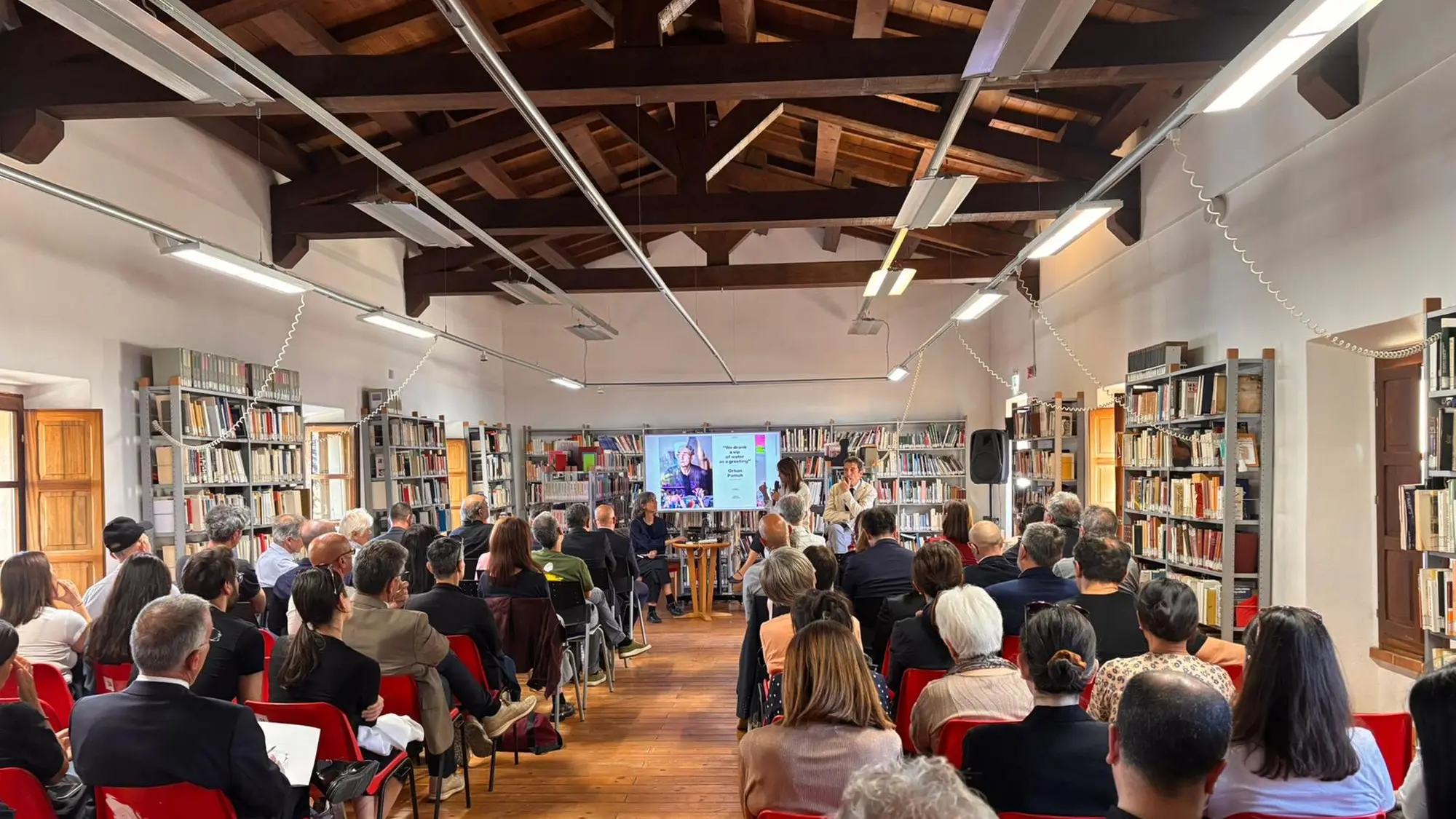


Last night, at the Pinacoteca di Oristano, there was an atmosphere rarely felt. That of culture that isn't exhibited, but rather present. A large and diverse audience filled the hall to attend the presentation of "Alfabeti/Alphabets," the magazine of the Venice Biennale, brought to the city by two exceptional guests: Pietrangelo Buttafuoco, President of the Biennale, and Debora Rossi, Editorial Director of the Magazine and Head of the Historical Archives . Engaging with them, opening spaces for reflection without ever slipping into the decorative, was the host, Silvia Loddo, Director of the Pinacoteca, who has a far from formal connection with the Biennale, having worked for the institution in the field of archival research.
A metaphor ran through the evening like a common thread, recurring repeatedly throughout the conversation. A hen that goes out, searches for seeds, and returns, always bringing with her something new and precious. A simple, almost domestic image, yet extraordinarily effective in describing what "Alfabeti" aims to do, and what art, in its most authentic form, has always done. Gather. Return. Enrich. It is in this tension between departure and return that the magazine finds its raison d'être. Not a publication to be leafed through absentmindedly, but an object to be inhabited, just as one inhabits a place. And Buttafuoco spoke of places, with his characteristic expressive force. The importance of being in the full sense of the term, of staying in a place, recognizing a community, building together. A concept that stands head-on in opposition to the logic of beehive constructions, those anonymous and serial architectures that empty existence of meaning, that generate alienation instead of belonging. Dwelling is a cultural and political act even before it's a physical one. It's no coincidence, then, that a magazine like "Alfabeti" was launched in Oristano, home to artists accustomed to getting their hands dirty with ceramics. "There's a profound coherence in this choice," Buttafuoco emphasized. "No place is innocent, no detail ever is. And a project that deals with language, with the search for truth, with the need to nourish it, finds a home in Oristano that recognizes it."