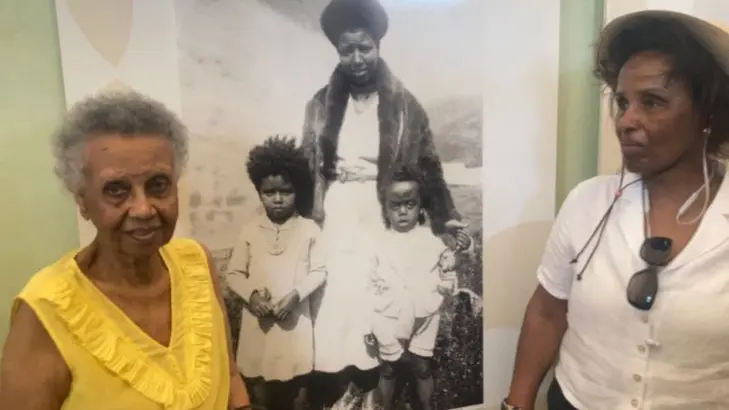


"It was emotional to return here to the island of Asinara; I appreciated the warm welcome. I'm not as clear-minded as I once was, but I remember that this place was full of prisoners back then, with Ethiopian women and children living in a single house, with only one point of contact where we could get food."
In the eyes of Yeweinshet Beshah-Woured, now 94 years old, the only direct witness to a dramatic period in Ethiopian-Italian history , one can read the desire to return to the place where she lived for several months, together with the approximately three hundred people deported from Ethiopia when she was only six years old.
He did so almost ninety years later, along with 60 other descendants of exiled Ethiopians, to share a moment of remembrance. They saw firsthand an island that holds a place for them, traces of the stories of deportation of a people repressed by the Royal Italian Army and, from 1937 to 1939, partly exiled to Asinara during the period in which Italy and its dictatorial regime pursued the goal of establishing a colonial future in the Horn of Africa. The aftermath of a tragedy recounted over the four-day event organized between Porto Torres and Asinara from August 5th to 8th, an initiative of great cultural value that reopened a sad page in history, lest we forget.
The project, titled "From Oblivion to Memory. The History of Ethiopian Deportees to Asinara 1937-39," is the result of meticulous research by the Sealand Asinara cooperative, an idea born in collaboration with the Asinara National Park, the Municipality of Porto Torres, the Association of Exclusive Guides of Asinara (A.Gu.A.) chaired by Paola Fontecchio, and the Educando Asinara Network.
"I felt safe because my mother, who was pregnant at the time, and my four-year-old brother were close by. I don't have any bad memories, but I do remember that they later transferred us to Rome," adds Yeweinshet Beshah-Woured, deported to Asinara after her father was killed in the Addis Ababa massacre. Ministers, magistrates, soldiers, ambassadors, and members of the Ethiopian elite and ruling class were deported to the island between March 1937 and July 1939, after the assassination attempt in Addis Ababa against the viceroy of Ethiopia, Rodolfo Graziani.