

One of the oldest mausoleums in the monumental cemetery of Guspini, built in 1873, belongs not to a local notable, but to a German technician who died while working in the Montevecchio mines . The disappearance of the main inscription—two large marble or brass slabs held together with pins, now lost—prevents determining whether the cause of death was illness or an accident at work. However, the features of the artifact, crafted from local Sardinian granite, are clearly attributable to Masonic symbolism, which was widespread among technicians in the industry at the time.
On the base stone, the only surviving inscription carved directly into the rock, reads: I NG. GHELMO HELLMANN and THERESA A. HELLMANN . The surname Hellmann harks back to the period between the late 19th and early 20th centuries, when engineers and managers from Germany, Belgium, and France settled in Sardinia to manage the mining industry. The fact that an important engineer from Montevecchio chose to be buried in Guspini ties his family inextricably to the local community: Hellmann wasn't just passing through, he was a full-fledged resident.
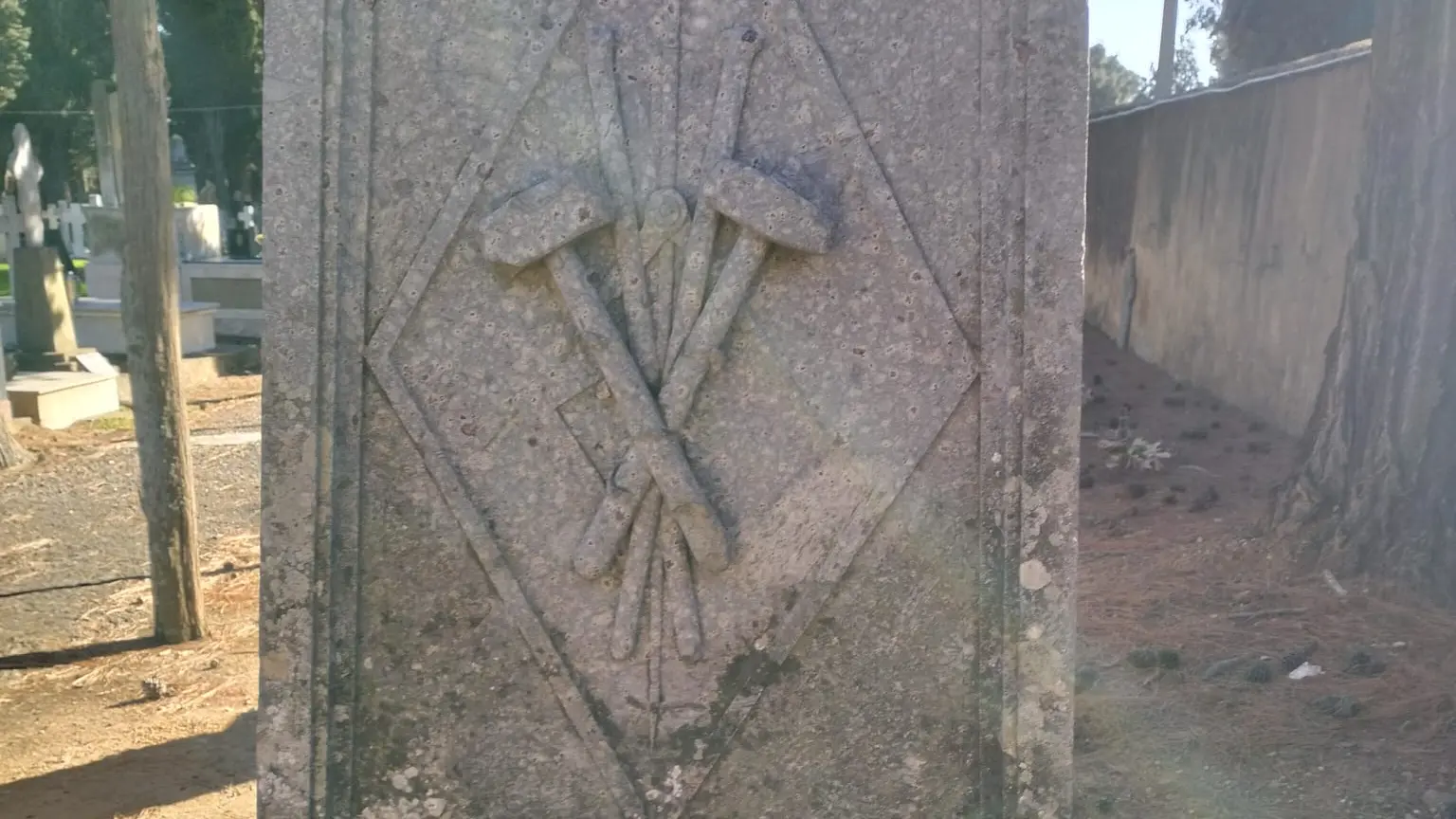
The remains of the mausoleum reveal a key detail: the large diamond-shaped relief depicts a highly skilled professional . The frieze combines two distinct symbols. On one side are the tools of the trade: two crossed miner's hammers (a mallet and an awl), surmounted by a surveying instrument. On the other, the compass and square explicitly recall Freemasonry. Between the late 19th and early 20th centuries, moreover, much of the ruling class of Sardinian mining companies belonged to lodges that welcomed both Italian and foreign technicians.
The monument appears as a square-based pedestal surmounted by a large hemisphere. Above, four small spheres could indicate the members of the family nucleus or the four cardinal points resting on the cosmos ordered by science. For a miner, however, they also represent the nodules of raw mineral that, once worked, reach perfection: it is the symbolic transition from formless matter to the "stone of completion." On the sides, you can see the pins that held the ancient dedications, while next to the Masonic symbol, two other slabs are missing, recently integrated with dowels and unfortunately also lost.