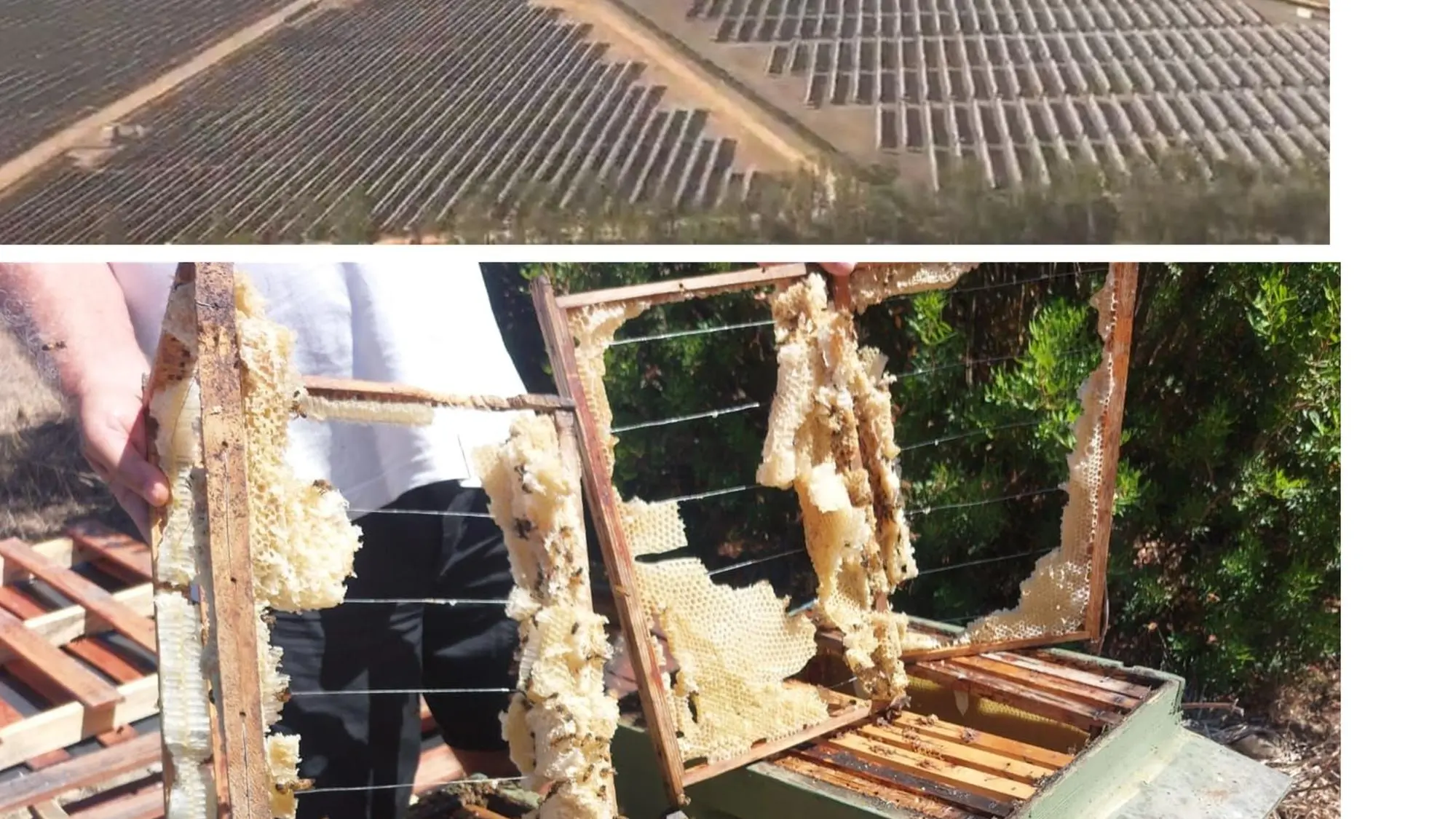


They don't know what else to invent. The latest frontier of " green washing ", marketing that uses "green" to cleanse its conscience of speculation and business, anything but environmental, is that of bees. The move is punctuated with ever greater insistence thanks to a media hammering by a "family" format mill. The implication impressed in the fairy-tale images produced by the most extreme green monetization is eloquent: solar panels are the natural habitat for bees too.
Hands up
In other words: let's cover our backs, let's use the "let's save the world thanks to bees" advert to guarantee ourselves a media pass for hundreds of hectares of environmental and landscape devastation, deluding the most profane that the "advert bees" can fly undisturbed among wildflowers and overheated panels. The most daring photovoltaic masters, now that the castle of green business on the head of Sardinia is crumbling project after project, are even trying the beekeeping card: an ideal illusion, imaginatively salvific, for those who would like to place "pro-honey" hives among silicon panels and olive trees, sowing a bit of "wildflower" grass here and there, as if Alice's town were Pabillonis.
Selling “bees”
A communication strategy that has even made inroads into the National Commission of the Pnrr, the same one that last week gave the green light, against the heavy opinions of the Superintendency and the Region, to a project that entrusts beekeeping with the function of "guarantor" for a mega project of 86,160 photovoltaic modules. Panels in pure crystalline silicon, rigorously Chinese, all directly produced by one of the primary companies in the Chinese province of Xinjiang , a production area subject to the application of the " U igur law" wanted by the United States against the exploitation of the poorest populations in the Far East.
“Solar” exploitation
It matters little if the exploitation of men and women, on the other side of the world, in the most unknown China, is at the base of the production of those solar “grills” that will cover land and vegetation on the island of Sardinia: the image of bees, “sold” with four lines in a project of almost 40 million euros of agrivoltaic, is the most eloquent symbol of the new solar . No one, however, has asked the question that the entire scientific community, the free one and not on the payroll of “solar-dollar” associations, is trying to examine in the light of increasingly frequent phenomena of areal “overheating” where the panels become an immense desert of silicon.