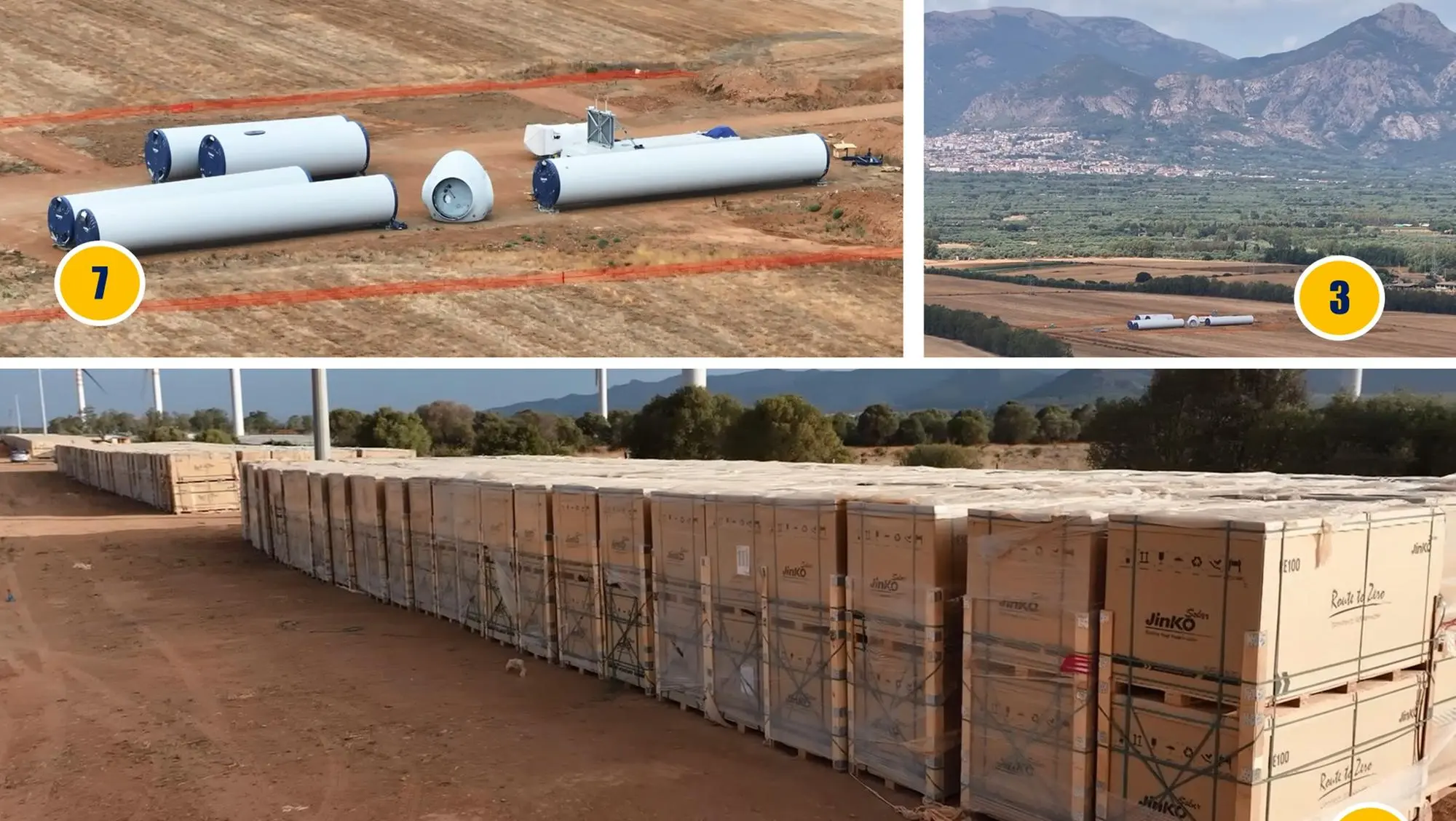


The "steel arms" of the wind cranes that came from afar began to climb onto the horizon of the great mountain of the "Land of Shadows". The skyline of Villacidro has always been Monte Linas, an indelible mark of the archaic history of a "middle ground", between the Campidano and the Marmilla, between the Oristano area and the Cagliari area. Initially the slopes were devastated by petrochemistry and primary metallurgy, with the Snia chimneys and the San Gavino foundry, then the first wind towers arrived from Bolzano and the surrounding area, placed there in front without knocking on the door of Sa Spendula. The "shadows" of those first high-sea flying "slicers" crashed as a "foretaste" of an immense energy speculation destined to overturn what was the industrial area of Villacidro. Now, having consumed every square meter of what remains of that "cemetery" of state industries, the "lords of the wind" have turned their gaze to the last green landscape of this agricultural strip.
Industrial landscape
The last frontier of lush lands and irrigated fields that has remained untouched and untouched until today must be transformed into an "industrial landscape". Night and day, under the sun and under the moon, here, between Pimpisu and the village of San Michele, the mechanical vehicles have not created access paths, but imposing highways of dust and enormous earthworks. The large articulated trucks from the Port of Oristano now travel fully loaded, including those unclean "propellers" that have reached those prairies torn away from agriculture a few days ago. Everything is placed in ten squares, all gutted prematurely, to strengthen the depths with reinforced concrete, no less than a thousand cubic meters of concrete injected into the subsoil, all surrounded by a hydrogeological danger that the maps indicate as "high".
Spy construction site
The one in Villacidro, the construction site of Das, the Piedmontese company landed in Sardinia, is a "spy construction site". It is, in fact, the first case study of the "moratorium law" approved on 5 July by the Regional Council. All authorized, let it be clear, for some time now, despite the many perplexities and doubts about that project. This start of work, however, is the first to have to measure itself against the legislative "consistency" of the new regional law which has established a "generic" and "indefinite" " " . A passage still today without any concrete and objective confirmation: what is blocking that law? What are the “banned” works? The law not only doesn't say, but it doesn't even limit the timing of those bans. For example, it does not frame the ban on the "start date of works", it does not identify a completion threshold to be reached within which to block the construction sites. One element, however, seems to indicate a "threshold" beyond which action should be taken, without hesitation. It's all written in article one, the one that should outline the "route" and the " " of the regulatory provision: « ".