









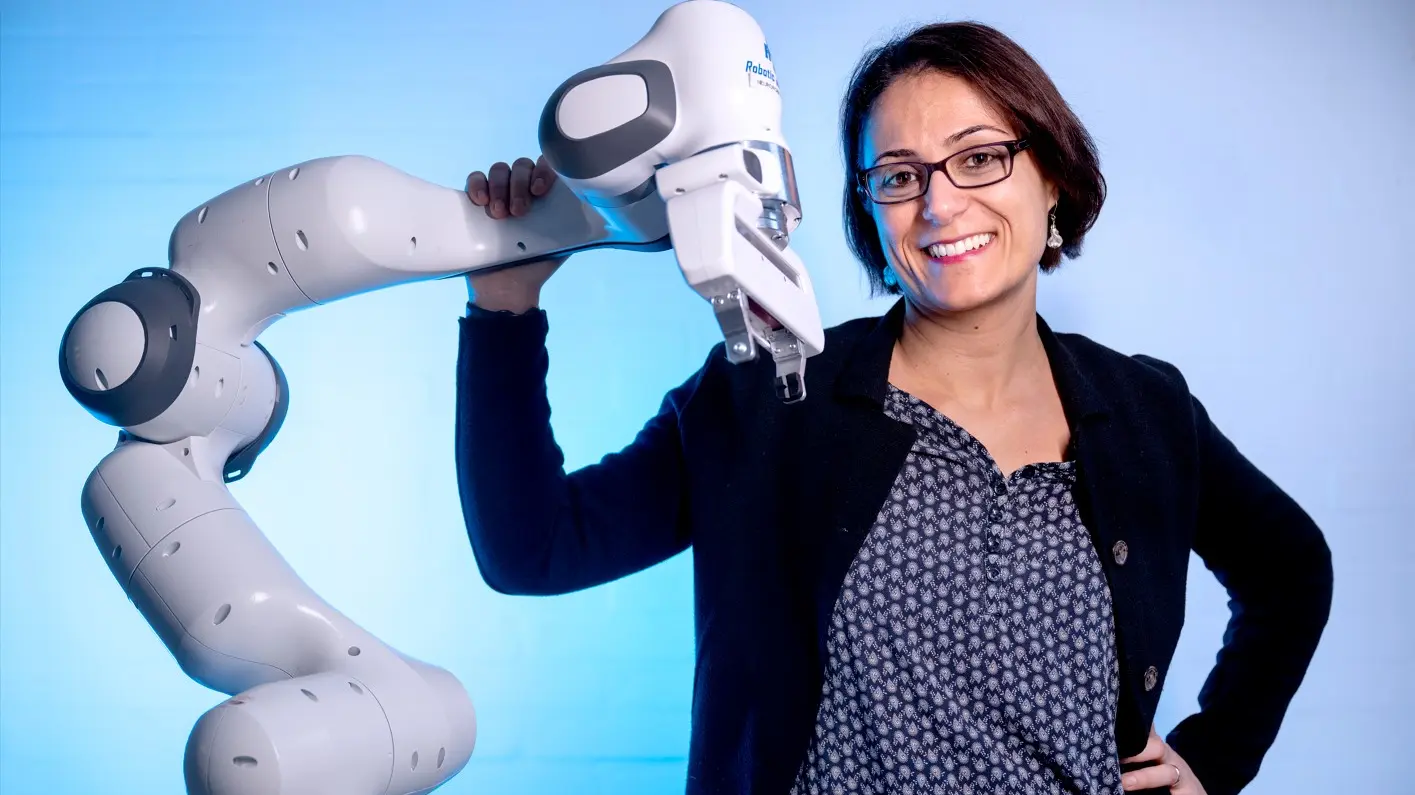



One week changed her life. Seven days and fate took her to Northern Europe where she now carries out her studies in Denmark, causing Italy to lose a great deal of human capital. A brain on the run, you could define it, but also a brain that studies the brain. Silvia Tolu, university professor at the DTU, Technical University of Denmark, roots in Elmas, nostalgic for the sea and food and "above all for the tranquility of Sardinia", today conducts important research in the field of Neuro-robotics in Denmark.
Studies
After graduating in Electronic Engineering from the University of Cagliari, having done Erasmus in Granada in Spain, where she was supposed to stay for five months and instead stayed for five years with study and doctorate contracts, she attended a master's degree in Electrical Engineering computing networks and participated in some tenders to continue his studies. Between the Sant'Anna University of Pisa and the Danish one, located a few kilometers from the capital Copenhagen, the Northern European university was the quickest to respond to the professor originally from Sardinia and so, today, after about ten years and some contracts and research grants, his studies contribute to improving the appeal of the Technical University of Denmark and above all to providing answers that until now were more difficult even in the field of medicine.
The research
Silvia Tolu's studies are focused on robotics applied essentially to the brain and cerebellum. There are no invasive interventions on patients, «but essentially we create computational models that are inspired by real ones. We start from the theories of neuroscientists, transform them into equations and neural networks that reproduce neurons", explains Silvia Tolu. In essence, these models recreate the functions of how the human brain provides input for movements and how the various areas, from the frontal ones to the spinal column ("each has its own function", explains the Sardinian teacher), communicate with each other. Through the models created by Neuro-robotics, "it is possible to understand where to intervene and also understand the mechanisms when they don't work". The interaction between the various parts of a human body «is very complex», but through the robots recreated in the laboratory, in essence, it is possible «to have supermodels, supercomplicated, which allow us to study the interactions more easily. Otherwise, with traditional methods, it would never be finished", adds the professor originally from Elmas. In essence, these neural networks are becoming increasingly closer to biological ones and "ensure the possibility of learning but making the most of resources".
The diseases
For example, applying this research to Parkinson's, «once we have the model, we take the data of the muscles or skeleton, analyze position, speed of movements and other parameters, put them in a model and obtain systems as a result that will allow us to quantify tremor, for example. How do we do it? We perturb a model until the symptom occurs." In essence, with this system that uses artificial intelligence and robots it will be possible to "anticipate the diagnosis" and obtain early detection of the disease. For Parkinson's, adds Tolu, there is no cure but it is possible "to study in this way the effects that therapies have to slow down the disease or to identify the best rehabilitation methods". There is still a lot to do in this field but "we are also studying how the combination of visual, audio and motor stimuli can be used to slow down symptoms and all this is possible thanks to the models we have developed and are studying". Even to the point of understanding how "a patient's brain can respond to rehabilitation".
Ideal place
Today, the studies carried out by Silvia Tolu in Denmark could hardly be transferred elsewhere. Collaboration with the purely medical sector allows researchers to have a lot of data available and to follow the effects of the experimentation step by step. «And then with two children today it is difficult for me to move around», adds Silvia Tolu, also because Denmark ensures full equality between fathers and mothers in the management of their children, the schools are open until 5pm and host the children even when they are not there. lessons, and "they look at you badly if you leave work after 4pm and aren't with your family". A different world, where family relationships are valued, even if Sardinia is missing. “I intend to buy a house on the Island,” he announces. Therefore, detachment from her homeland is difficult but Silvia Tolu's studies will certainly be able to enrich our region and provide solutions to Sardinian patients too.
Giuseppe Deiana