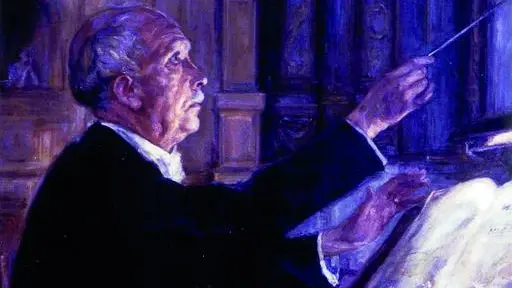


Germany, 1932. Nazism is preparing to seize power. One day, the great pianist Jascha Spivakovsky, a Jew, receives a strange message: a sheet of paper, a musical staff with a few handwritten bars. It's a passage from the first movement of Gioacchino Rossini's William Tell Overture, known as "The Tempest." After the notes, an exclamation point. That's enough for Spivakovsky, 36, to realize that things are looking dire for him. He quickly flees from Germany, which is slowly marching toward the illusion of the Third Reich, and seeks safety.
The person sending him that coded message was Richard Strauss, the great composer, now almost seventy, who decades earlier had set Nietzsche's Zarathustra to music. Time was running out; he had to hurry. On January 30, 1933, just days before Adolf Hitler's appointment as Chancellor, Spivakovsky embarked on a seventy-concert tour of Australia and New Zealand. It would be a resounding success: leaving the nightmare of the Third Reich behind, the pianist settled in Melbourne and obtained Australian citizenship in 1938.
An uncommon talent
The story is recounted in biographies dedicated to Spivakovsky and on his official biographical profile, but those texts are not translated into Italian. This writer stumbled upon it by chance: on YouTube, among the comments on a video dedicated to Strauss's famous, poignant last four lieder, one posted five years ago was highlighted: "Richard Strauss saved my grandfather's life."
Born in 1896 in Smela, near Kiev, then part of the Russian Empire, Jascha Spivakovsky displayed extraordinary musical talent from childhood. His family moved to Berlin after the anti-Jewish violence that struck Odessa in 1905. In the German capital, the young pianist studied at the Klindworth-Scharwenka Conservatory and quickly established himself as a leading performer. In 1910, at just thirteen years old, he won the prestigious Blüthner Prize, attracting the attention of musicians and critics.
After the First World War, his career flourished, making him one of Europe's most highly regarded pianists. In the 1920s, he performed with major orchestras and formed a duo with his violinist brother, Tossy. In 1930, together with cellist Edmund Kurtz, he formed the Spivakovsky-Kurtz Trio, which was enthusiastically received by critics. The very prestige he achieved in his interpretation of German repertoire would have angered the Nazis, who believed that a Jewish musician could not authentically represent the national musical tradition. According to the biography published on the pianist's website, Spivakovsky's concerts were hindered and his work attacked by the regime-affiliated press.