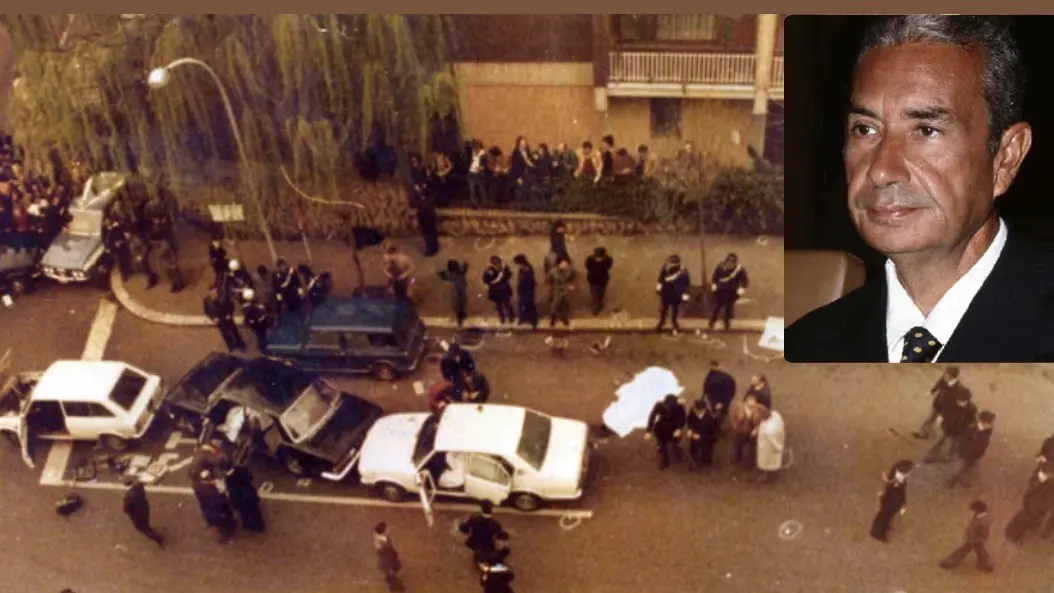


Seven letters, two places, and a bizarre misunderstanding in the story of Aldo Moro's murder. Gradoli: the name that still sends chills down the spine nearly fifty years after one of the most ferocious attacks on the postwar state. In a town in northern Lazio, a futile search is underway for the Christian Democrat president kidnapped by the Red Brigades on March 16, 1978, while in Rome, on the street of the same name that leads to the Via Cassia, Mario Moretti, the man in charge of the terrorist operation, is hiding. Making everything even more surreal during the days of the kidnapping is a sinister twist: the word Gradoli, according to the protagonists' accounts, was not suggested by an informant. Instead, it was the spirits speaking.
The spirits speak
On Sunday, April 2, 1978, Moro had been held prisoner for seventeen days. In Zappolino, in the Bologna countryside, a group of friends was gathered in the home of Alberto Clò, a young professor at the university of the Emilian capital and a minister in the Dini government in the 1990s. Among them was Romano Prodi, the future prime minister and leader of the Ulivo party, also a professor at the University of Bologna. Also among them was economist Mario Baldassarri, later a member of parliament with the National Alliance (AN-PDL). Outside, the weather was foul; inside, someone was proposing the "saucer game": letters were arranged on a table and an object moved under the players' fingers. They were searching for answers from the afterlife. The testimonies also evoked figures from Christian Democrat history, such as Don Luigi Sturzo, Alcide De Gasperi, and Giorgio La Pira (who had died a few months earlier). The question was the one that haunted Italy: where is Moro? Among the confusing indications, Bolsena appears, then there is the key name: Gradoli.
The wrong track
It could have remained just a slightly macabre Sunday pastime. Instead, Prodi became alarmed and reported the incident to Umberto Cavina, an aide to DC secretary Benigno Zaccagnini. The tip reached the Interior Ministry, led by Francesco Cossiga. On April 6, investigators searched houses and land in the Gradoli area, in the province of Viterbo, near Lake Bolsena. No results. The name was correct, the location was wrong. In Rome, at Via Gradoli 96, there was a Red Brigades base used by Moretti and his partner Barbara Balzerani, another key figure in the terrorist attack. It's unclear whether it was one of Moro's prisons, but it was certainly an operations center for the kidnapping. And the investigators had already arrived at that door: on March 18, two days after the Via Fani ambush (in which five men—three police officers and two Carabinieri—members of the DC leader's bodyguard were killed), officers entered the building to conduct checks, as was happening on almost every street in northern Rome. They knocked on the apartment and left, without searching it. The failed raid was based on information from a resident: she spoke of strange ticking sounds at night, similar to Morse code signals—a detail not always reconciled. Some would later associate them with the clicking of the typewriter used to prepare the Red Brigades' communiqués, or even the letters Moro sent to DC leaders, his family, and the Pope.