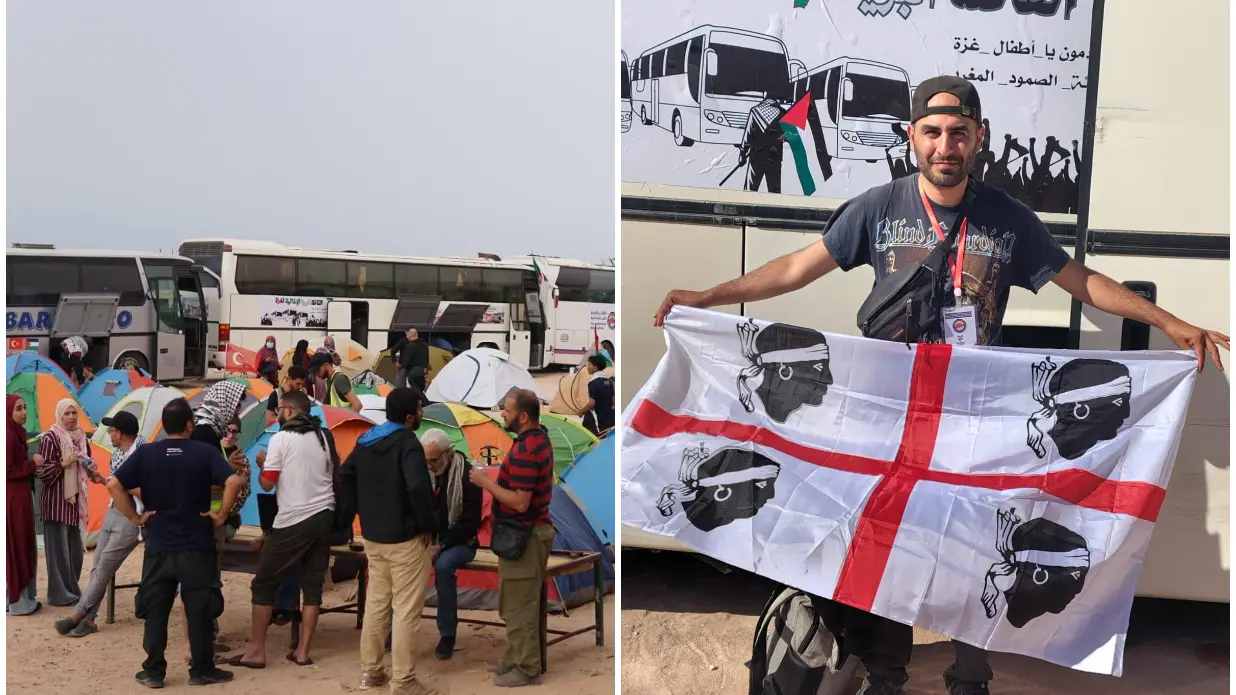


For now, the humanitarian convoy is 45 kilometers from Sirte, Libya, while the border with Cyrenaica is only nine kilometers. In this context, Filippo Boi, a 35-year-old photographer from Guspini, has chosen to document with images what is happening along the humanitarian route: with him, hundreds of volunteers camped in the desert amidst the heat, wind, and waving Palestinian flags. They are all waiting for the green light to cross the border and enter eastern Libya, the first step in a mission that aims to reach Gaza.
"We've been stuck here for five days," he says. "The situation is constantly evolving, and rules and authorizations change every day." Nearly four thousand kilometers from home, Boi is the only Sardinian present in the international overland mission, made up of dozens of convoys and activists from all over the world: Europe, the United States, South America, and Asia. "There are people from Argentina, Uruguay, China, Indonesia. A huge mobilization for this cause," he says. Now they're waiting for the green light to continue their journey. "First we'll enter eastern Libya, then we'll cross over to Egypt, and finally Gaza." From a security standpoint, he explains, "we're just a few kilometers from the border, and for now, we're calm."
A professional photographer specializing in concerts and social reporting, Boi has long been following the movement surrounding humanitarian missions to Gaza. "I started by covering last year's mission. I had photographed the departure of another Sardinian activist, Marco Loi, and from there I continued to gather information and follow all the demonstrations related to this cause. When the opportunity arose, I felt I had to be there, and I applied to be a photographer."
He carries essential photographic equipment. "I brought a Sony A6000 mirrorless camera because it's lightweight and because, if something were to happen, the financial damage would be limited. Practicality is key here." The shots taken during the trip, "which are still of high quality," he admits, are uploaded as soon as possible via satellite links and shared on the mission's channels. Communications, however, aren't easy. "The connections work intermittently, and making a phone call takes a lot of luck. We have a Starlink connection, but the signal isn't stable; it changes from day to day, and at times we're isolated. We also purchased local SIM cards, but here the phone signal often doesn't work at all."