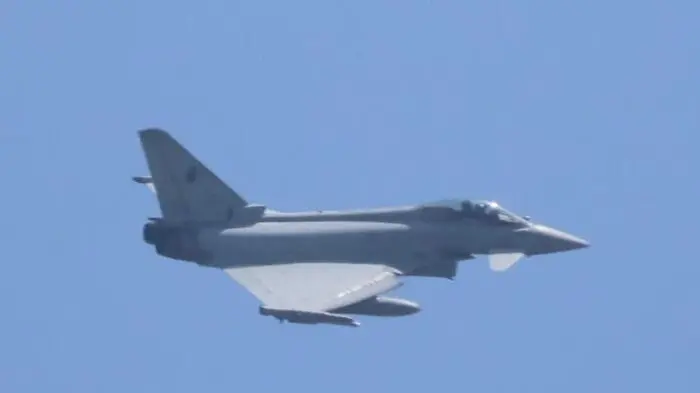


The escalation of the war in Ukraine is dangerously close to NATO's borders, in a series of incidents that are being branded as "provocations" on both sides of the border: during the night, two Italian NATO Eurofighters were forced to take off to shoot down a drone that had violated Lithuanian airspace , with Defence Minister Guido Crosetto - on a mission over the Eastern Flank - casting his suspicions on Moscow, reporting that it was a Shahed-type aircraft.
Just a few hours later, the Danish military reported that a Russian frigate had fired two flares at its military helicopter off the country's coast, narrowly missing it . And in the evening, alarm was also raised in Germany, where authorities reported the discovery of drone fragments a short distance from the Wunstorf military base .
NATO's eastern border is no stranger to border encroachments: among the most serious was that of May 19, when NATO fighters shot down a Ukrainian UAV over Estonia for the first time. This time, the drone downed in Lithuania, which was carrying an explosive device , is suspected to have been of Russian origin. According to Crosetto, this incident highlights the "fundamental" importance of the Italian military on the Eastern Flank : after stressing from Warsaw that "defending Poland means defending Italy and Europe," the minister continued his mission in Lithuania, where he personally thanked the Italian fighter pilots who shot down the drone and emphasized that "peace is achieved through the capacity for collaboration between multiple countries."
A call for unity is more urgent than ever in the aftermath of the Russian attack on the train near the Polish border : in the past few hours, the Russian Defense Ministry released video of a new drone attack on the same border crossing that was struck on Sunday. Adding fuel to the fire was Putin's advisor, Nikolay Patrushev, who predicted that if Warsaw were to declare war on Russia, "the Polish state would cease to exist in two or three days."