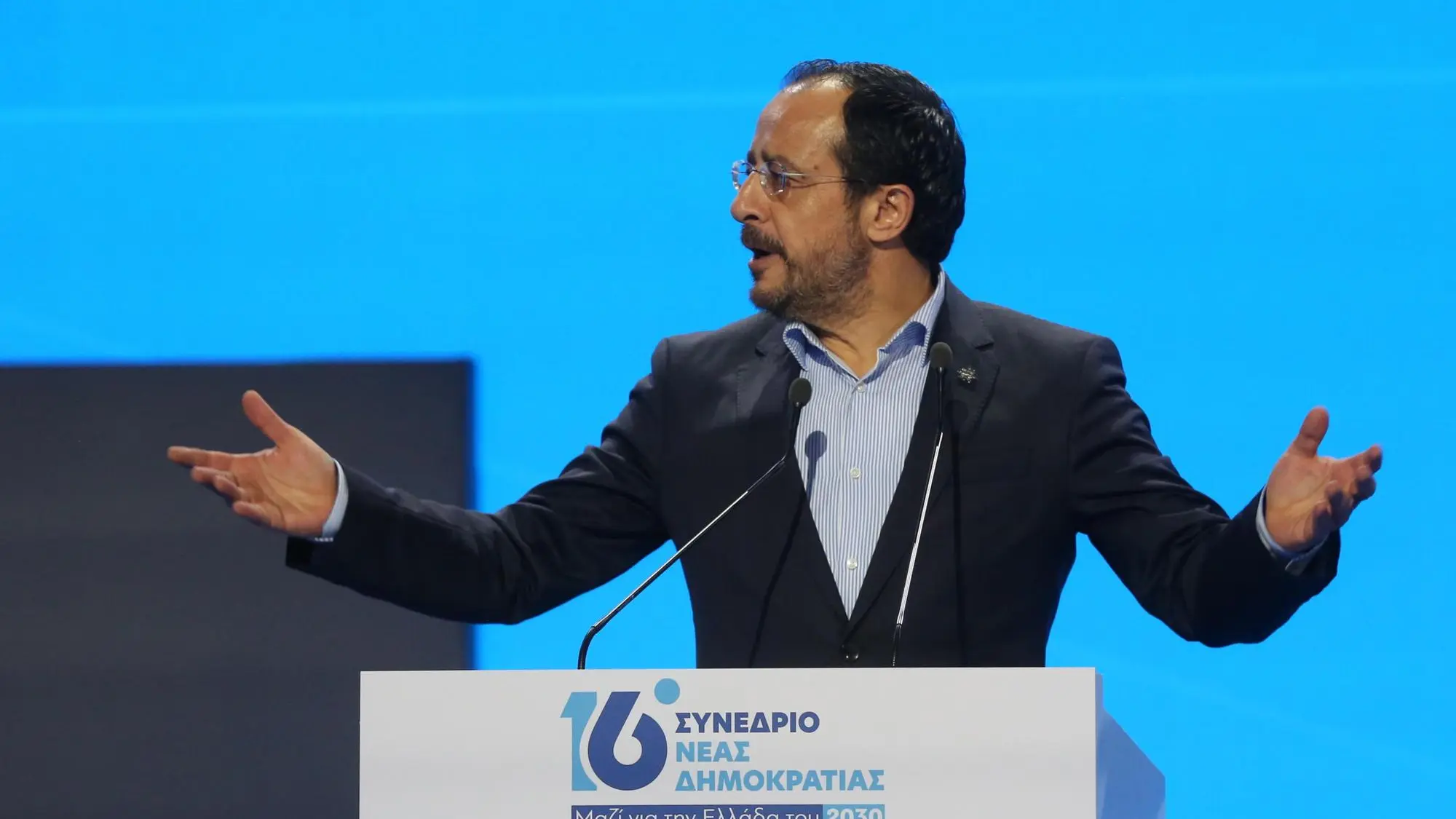


At the Summit held in Nicosia, the President of Cyprus, Nikos Christodoulides, who is also the President-in-Office of the European Union, made some very interesting statements regarding the need to achieve de-escalation in the Gulf region to ensure the security of the Strait of Hormuz.
According to press agencies, the President of Cyprus has argued and declared that the Gulf countries rely on the European Union, willing to cooperate with it to prevent the long-awaited de-escalation from being achieved. In other words, according to the current President of the European Union, the security of Hormuz, as well as, essentially, its reopening to free and unconditional transit, could be guaranteed and assured by cooperation between the European Union and the Gulf countries. Well, no question about that, provided the European Union presents itself to the world—and it doesn't yet appear to be one—as a genuine political and strategic federation, and not simply as a mere composition of twenty-seven member states. There's much talk of the so-called Pact for the Mediterranean, which, essentially, should help relaunch a strategic vision based on shared development, energy transition, and social inclusion. But, probably, at this stage, and as far as one might understand, it would appear to be configured almost like a broad-ranging geopolitical choice aimed at strengthening the role of the European Union, which is not yet a federation. This, at least, is the impression one would get.
The European Union, to date, still hesitates to express a unified strategic vision. It is one thing to present itself within the new international dynamics as a true federation (which would give complete meaning, strength, and practical substance to the Pact for the Mediterranean), but quite another to present itself as a coalition of nation states pursuing specific but not necessarily shared objectives. This means that anything is possible, as long as there is clarity in the approach. This is all the more true when another factor cannot be overlooked: that for Washington, too, relations with the Gulf countries have long had, and continue to have, a powerful economic and security significance, not least as a counterweight to Iranian influence in the region. And even more so when strengthening alliances with the Gulf countries plays a strategic role, especially at a time when the United States is engaged in a bitter tug-of-war with Iran, which seriously threatens to undermine all existing geopolitical balances.