
















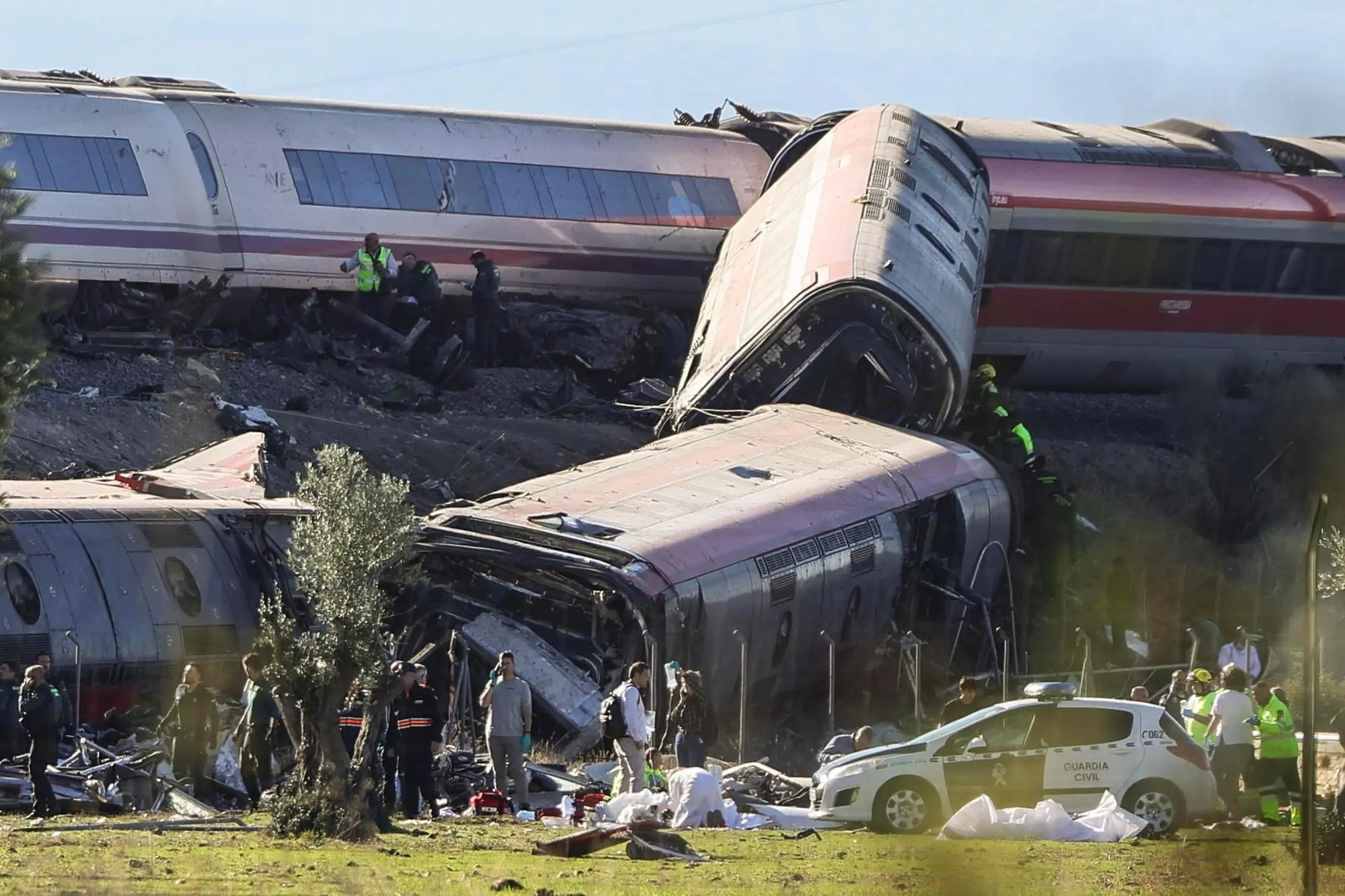
A Sardinian, originally from Sassari and living abroad, is among the Italians involved in the deadly train accident in Toledo, Spain, where the collision between two high-speed trains resulted in at least 68 deaths and 107 injuries, 18 of which are in serious condition, according to the latest official toll. The Ministry of Foreign Affairs and International Cooperation (MIF) announced this based on the passenger list of the Iryo train and initial information about the Renfe train.
According to an update from the Ministry of Foreign Affairs in Rome, five Italian passengers have been recovered in stable condition from the two trains involved, a sixth Italian national is hospitalized in Toledo; three other Italian women are still missing.
The Farnesina is monitoring the situation in coordination with the Italian Embassy and Consulate General in Madrid. At the request of Foreign Minister Antonio Tajani, a team from the Consulate General will continue to visit local hospitals and survivors' shelters to gather information and provide assistance to Italians.
The collision occurred at 8:54 a.m. on the high-speed line between Madrid and Seville, in the autonomous community of Castile-La Mancha, at kilometer 118 near Urda, not far from Toledo. According to the reconstruction provided by Spanish Transport Minister Oscar Puente, a Renfe train struck an Iryo train that was stopped on the tracks.
A tragedy even worse than the one experienced just nine months ago, one that no one thought could happen again, on the same southern corridor between the capital and Andalusia. In Adamuz (Cordoba), an Iryo derailed and collided with a Renfe Alvia, killing 46 people. This time, too, the victims were a public company Ave and an Iryo—a company owned by FS International— carrying 397 and 147 people, respectively, including a newborn. The first train, traveling at approximately 200 kilometers per hour, struck the second, which was stopped due to a fault in the control system at the Urda station. The most disturbing question, however, concerns the minutes preceding the collision, which occurred at 8:54 a.m., according to Puente's reconstruction . At 8:30 a.m., a communications failure in three computers on the network knocked out the LZB safety system along a stretch of approximately 63 kilometers.
The anomaly would have caused the automatic stop of all six trains in circulation, including the two involved in the collision. With the main system out of service, the ADIF control center at Madrid's Atocha station would have taken over management of rail traffic. It was at this stage, according to the minister, that the crucial human error occurred: the Renfe train was authorized to restart, even though the Iryo was still stationary on the line.
"There was a red light that prevented the train from resuming its journey, yet the AVE train was authorized to restart," Puente explained. The train then traveled 25 kilometers in 17 minutes before reaching the Iryo at approximately 200 kilometers per hour, hitting it head-on. The minister called this sequence "inexplicable." "A rear-end collision on the Spanish rail network is truly unbelievable," he maintained. Investigators are examining communications between the operations center and the train drivers, as well as the procedures followed during the breakdown, with the possibility of human error at the center of the investigation. But responsibilities will have to be determined by the investigation.
"All of Spain is in mourning," declared Prime Minister Pedro Sánchez, who arrived at the scene accompanied by the president of the Castile-La Mancha Regional Government, Emiliano García-Págí. "It is unacceptable, in a country like ours, to have two fatal high-speed train accidents in one year," Sánchez acknowledged, promising to get to the bottom of it. "If there was negligence, it will be known. Now the priority is saving lives," he added, announcing three days of national mourning.
The tragedy has inevitably rekindled the wounds opened by the Adamuz disaster: even then, network safety and infrastructure maintenance were at the center of the national debate over the nearly 4,000-kilometer high-speed rail system, one of the symbols of Spain's fast-moving future. The train drivers' unions have called a strike for tomorrow, because the network safety measures agreed upon with ADIF and Renfe have not all been implemented. Now, the new accident reopens questions about the reliability of the rail system, which Puente has described as "safe," although "errors can always occur." ADIF has announced that trains between Madrid and Andalusia remain suspended, while Renfe has suspended ticket sales until December 13th.
(Unioneonline)