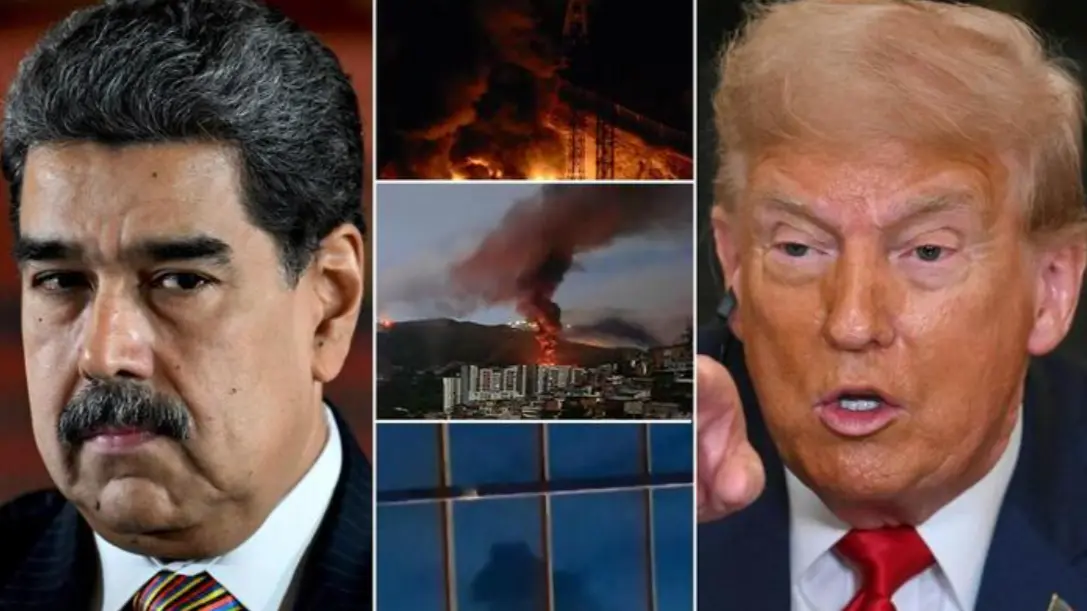


Following the attack carried out by the United States on the orders of Donald Trump, Venezuelan president Nicolás Maduro, accused by Washington of drug trafficking, was captured and arrested along with his wife by Venezuelan special forces, and immediately taken out of the country.
Pursuant to the Venezuelan Constitution, power has been transferred ad interim to Maduro's vice president, Delcy Rodríguez , who is expected to call elections within 30 days, so that the newly elected president would serve a six-year term. However, according to news agencies, Donald Trump declared, on the one hand, that the United States "will lead the country to a safe, proper, and sensible transition," adding, moreover, that "we don't want to be involved, nor do we want anyone else to take their place and find themselves in the same situation we've been in for the past many years," and, on the other, that the United States would "lead" with "full access to oil."
Meaning, among other things, that Maria Corina Machado, Nobel Peace Prize winner, would not be considered suitable for the position , since, according to what Donald Trump himself declared to the press, she "does not enjoy enough respect in the country".
This is the situation that has arisen. And questions about the legitimacy and correctness of the action/attack ordered by the President of the United States are swirling, creating considerable uncertainty about the potential consequences and international balances, already strained by existing conflict scenarios. To begin with, what happened to the so-called principle of non-interference enshrined in the United Nations Charter , Article 2, point 7 (1945) and in the Declaration of Fundamental Principles of International Law contained in UN Resolution 2625 of 1970? Is there anyone who can consider themselves "legibus solutus," that is, above the law?
The answers would clearly appear to be consistent, even if, at this stage, they are not unequivocal. First, because, based on the content of the aforementioned Article 2, point 7, of the United Nations Charter, it would not appear permissible, and in fact it is not, to use force, and/or any subversive/disruptive activity whatsoever, whether conducted directly or indirectly, and/or any economic or political behavior aimed at limiting the freedom of government, good or bad, of a sovereign state, in order to influence it to the will of another.