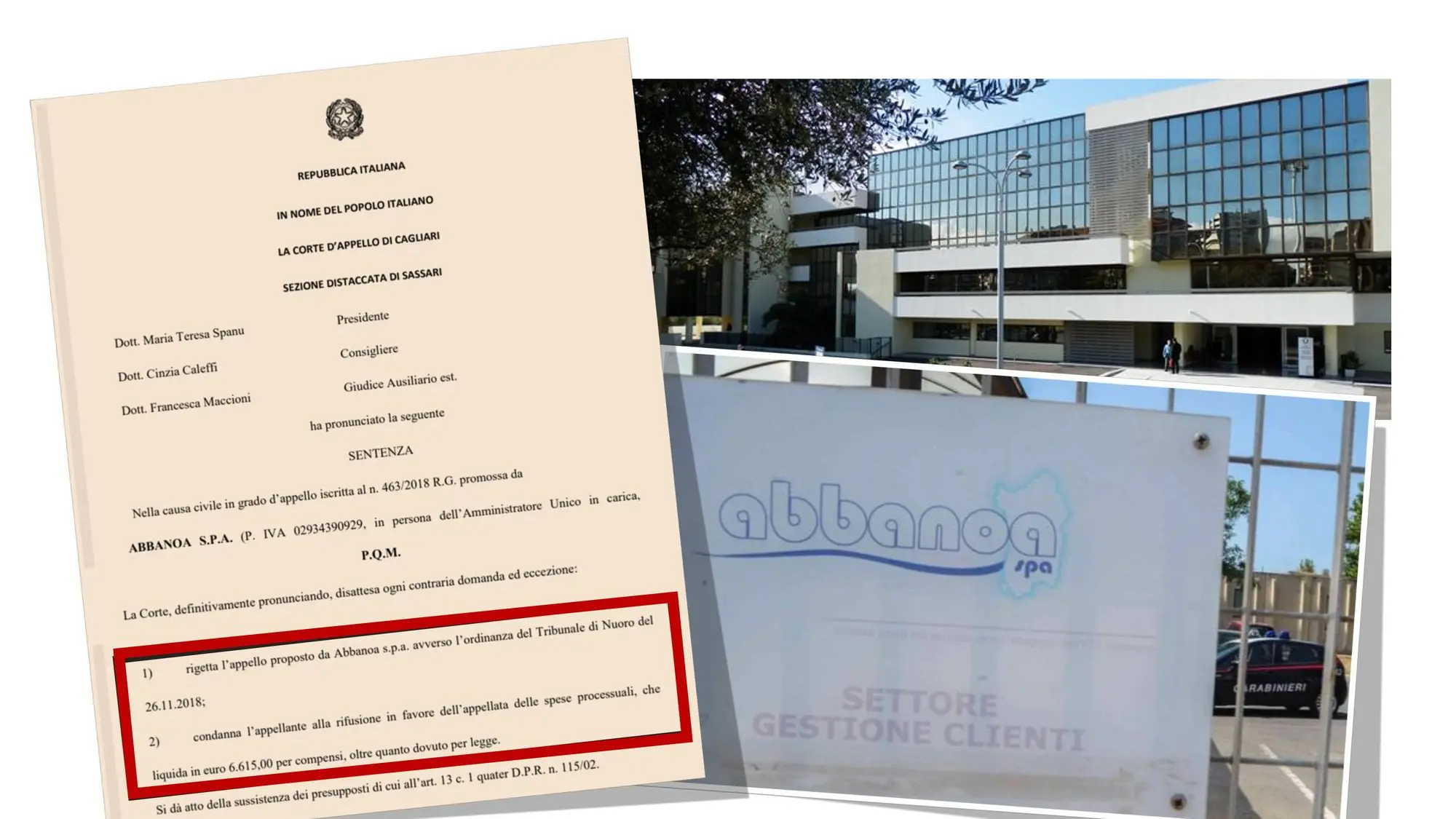


Maria Teresa Spanu, President of the section of the Court of Appeal of Cagliari, branch of Sassari, is a judge who does not look at anyone. The sentence just issued is one of the heavy caliber ones: the previous adjustments 2005-2011 issued by Abbanoa are outlawed. Not as a way of saying, but for a lesson in law that the panel of the Court of Appeal, with Cinzia Caleffi and Francesca Manconi, puts pen to paper in a decision that transforms the summer of Abbanoa into an unprecedented Caporetto. Not even 48 hours have passed since the fine of the century, 5 million euros, inflicted by the Antitrust on the water manager of Sardinia for unfair practices, which for the public water managers comes yet another very hard blow. A sentence that can weigh much more than the Authority's sanction itself.
106 million of adjustments
In fact, there are 106 million euros at stake, so much Abbanoa thought of collecting from those previous adjustments of 2005-2011 with bills "illegitimately" issued in 2017. The Court's ruling is "limited" only to those who have turned to First degree judges challenging those bills, but it is all too evident that the decision of the second degree magistrates "dismantles" the entire "system" of balances and those illegal withdrawals from the pockets of Sardinian families. More than a sentence, the one filed yesterday in the chancellery, is a manual of civil law, with a precise reference to the cardinal principles of the legal system, from the hierarchy of sources to non-retroactivity. To challenge those bills, complete with exorbitant adjustments, both unexpected and illegal, had been a group of tourism entrepreneurs from northern Sardinia who had decided to react to what appeared to be a not only financial abuse. The Court of Appeal declares that the adjustments were not a purely economic question, declaring: "This is a request for the protection of subjective rights".
No to unilateral changes
In practice, according to the Judges, the question concerns the foundations of civil law and the contractual relationship between the user and the manager of the water service. The key issue is the unilateral modification of the contract signed by both contracting parties. The substance is elementary: Abbanoa could not in any way, on its own account, in contempt of the bilateral negotiation relationship, modify the water service contract. Having added to the water tariff, moreover deliberately ignoring the statute of limitations, cost items relating to "phantom" adjustments, however not attributed to consumption, constituted a fundamental violation of civil law. Abbanoa has always defended itself by referring to the resolution of the Regulatory Authority of the water system. The judges are tranchant: the hierarchy of rules provides that the resolution of a "non-legislative" subject such as the Arera, which therefore does not have the power to make laws, cannot in any way prevail over the provisions of the Civil Code, the Gospel of right, until proven otherwise. The sentence of the Court of Appeal "cuts" without hesitation the claims of the water company, starting from the contestation of the procedural jurisdiction. In practice, Abbanoa asked the Court of Appeal to reject the sentence of the Court of Nuoro because he believed that the judges entitled to pronounce were the administrative ones and not the civil ones. The formula adopted by the Sassari Magistrates is clear: "The complaint is unfounded and the jurisdiction of the ordinary judge must therefore be confirmed."