











Italy will be at the forefront of the next lunar adventure. The country will participate in the new season of lunar exploration with technologies and infrastructure destined to become crucial: from Italian habitation modules to the future Moonlight communications and navigation network, a sort of lunar "internet" or GPS. And Luca Parmitano won't be the only one there: two other Italian astronauts are set to participate in upcoming missions.
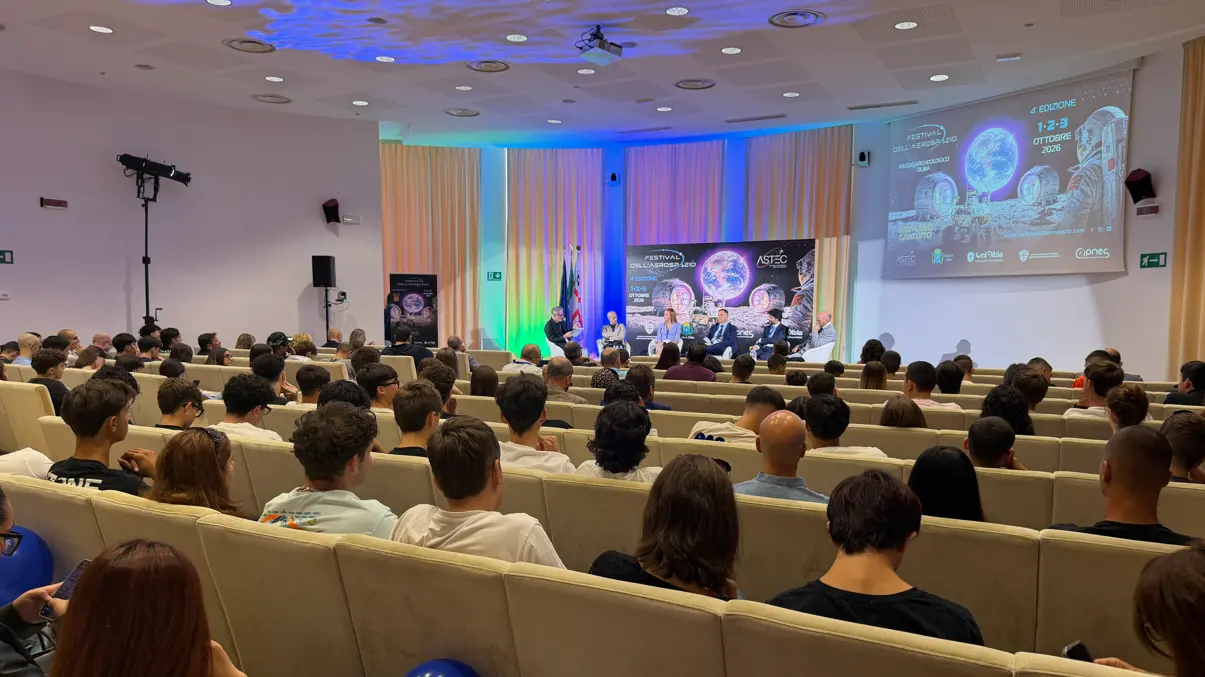
This topic was the focus of the first day of the Aerospace Festival, currently underway at the Archaeological Museum of Olbia, on the lunar space economy. Journalist Emilio Cozzi moderated and interviewed speakers Marcello Spagnulo, aeronautical engineer, writer, and scientific advisor; Mario Cosmo, director of research programs at the Italian Space Agency (ASI); Annamaria Piras, Director of the LEO and Artemis Programs Directorate in the Thales Alenia Space Domain of Exploration and Science; Vincenzo Giorgio, Vice President of Thales Alenia Space and CEO of ALTEC; and Ugo De Ceglie, CTO of Leonardo's Space Division.
The starting point was the profoundly changed nature of space cooperation. NASA has modified its strategic approach, and the return to the Moon is now part of an international competition in which the United States is the main driver. In this new scenario, Spagnulo explained, the weight of different countries will also depend on the technological and industrial contributions they are able to deploy. One consequence of this change concerns the Lunar Gateway, the international space station planned to orbit the Moon. America's priority is shifting toward a more permanent presence directly on the lunar surface. But, Annamaria Piras emphasized, the work developed for the Gateway has not been lost. The challenge, however, is not solely about technology. The real question is how to build a future lunar economy. "Today it's still a hypothesis," she explained, "but we cannot avoid starting to imagine it."
For this reason, it is essential to develop skills and infrastructure today that can be transformed into services tomorrow. This is the rationale behind the new which aims to guide and control from Earth the robots that will explore the lunar surface, testing technologies, systems, and experiments for the lunar surface. The center will serve to simulate the operating conditions of the Moon and transfer the skills acquired over twenty years of activity in low orbit to the lunar environment. One of the greatest challenges will be guaranteeing services and operations even during the long periods when astronauts are away. For Ugo de Ceglie, the strategic point is clear: . This is where a significant part of future competition will be played out. "Investing today in technology and innovation means capturing tomorrow's economic volumes," he explained, noting that








