









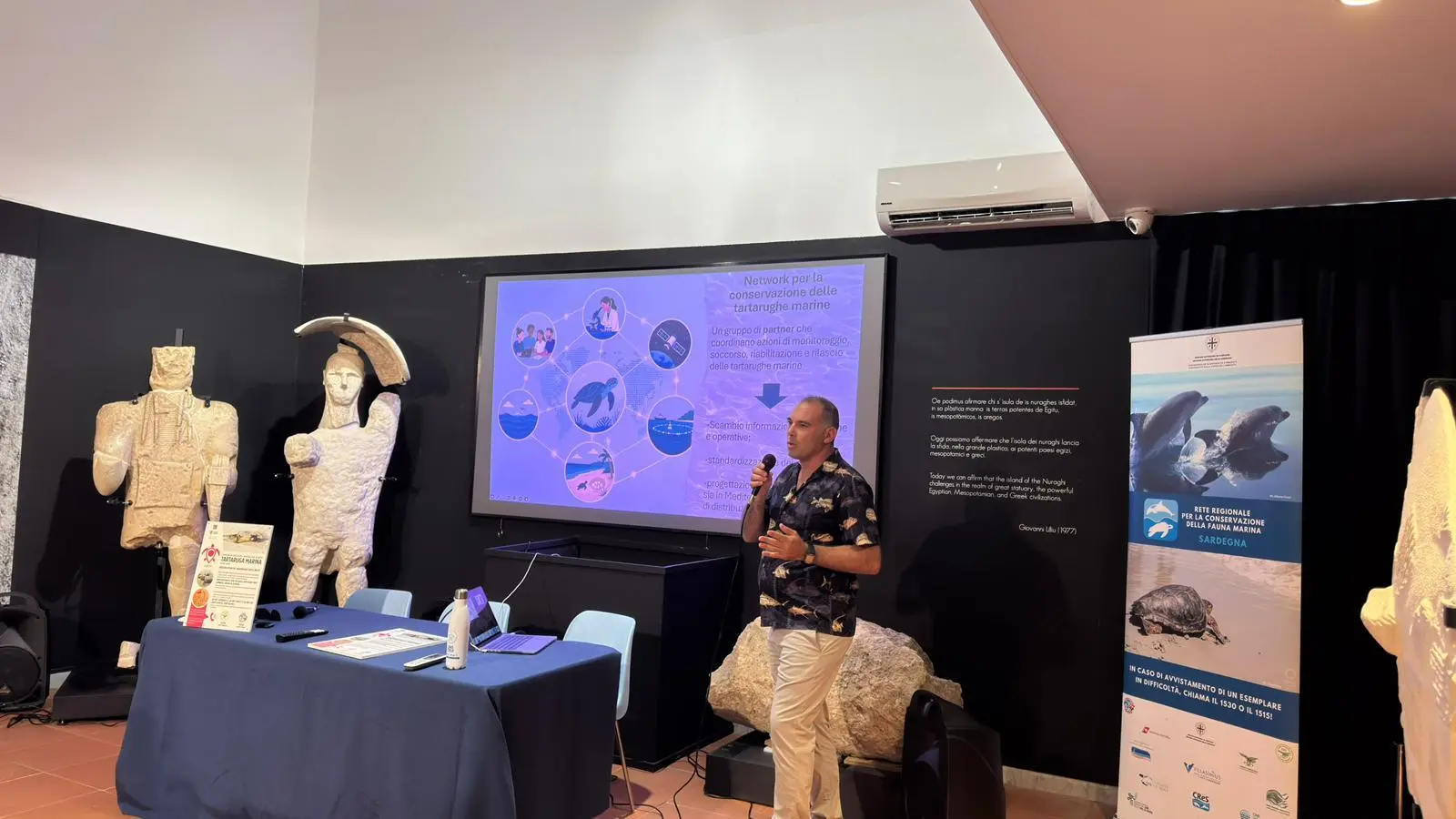


The first "Thursdays at the Museum" event, which brought the Cabras Museum to life yesterday, was well attended. The star of the show were sea turtles, and with them, a researcher who has been working to keep them alive for years. Andrea Camedda, a researcher with the National Research Council (CNR), took the stage with the Sinis Recovery Center (CReS) to discuss something that goes far beyond marine biology. "We're talking about a system," Camedda explained, "that we've built piece by piece, bringing together institutions, researchers, veterinarians, and protected areas. It's not just science: it's a network of people caring for a shared heritage."
The conference, titled "Without Borders: The Network for the Protection of Sea Turtles," focused on the Regional Network for the Conservation of Marine Fauna. " It's the first fully institutional network of its kind in Italy, coordinated by the Sardinia Region's Department of the Environment, with the CNR-IAS as scientific coordinator. It's a model that, it seems, is starting to gain traction elsewhere ," the speaker explained. Locally, the network centers around the Sinis Recovery Center, a facility that's much more than a shelter for injured animals; it houses a veterinary clinic, Marine Protected Area offices, research laboratories, and recovery tanks. "When a turtle arrives in distress," Camedda explained, "it enters a coordinated system. It doesn't simply end up in a tank waiting: there's a protocol, there's a team with the specific goal of returning it to the sea in the best possible condition."
The evening's focus was on the Caretta caretta, the most common sea turtle in the Mediterranean and among the most threatened. "Plastic is everywhere, and turtles ingest it, mistaking it for jellyfish. Accidental capture in fishing gear is a huge and often underestimated problem. And then there's climate change, which is altering migratory routes, foraging areas, and even nesting sites. This isn't a future crisis: it's an ongoing crisis," the researcher explains. "A sea turtle doesn't know where the Italian sea ends and the Greek or Tunisian one begins. It moves, migrates, follows the currents. To truly protect it, we must do the same: move together, beyond borders."








