









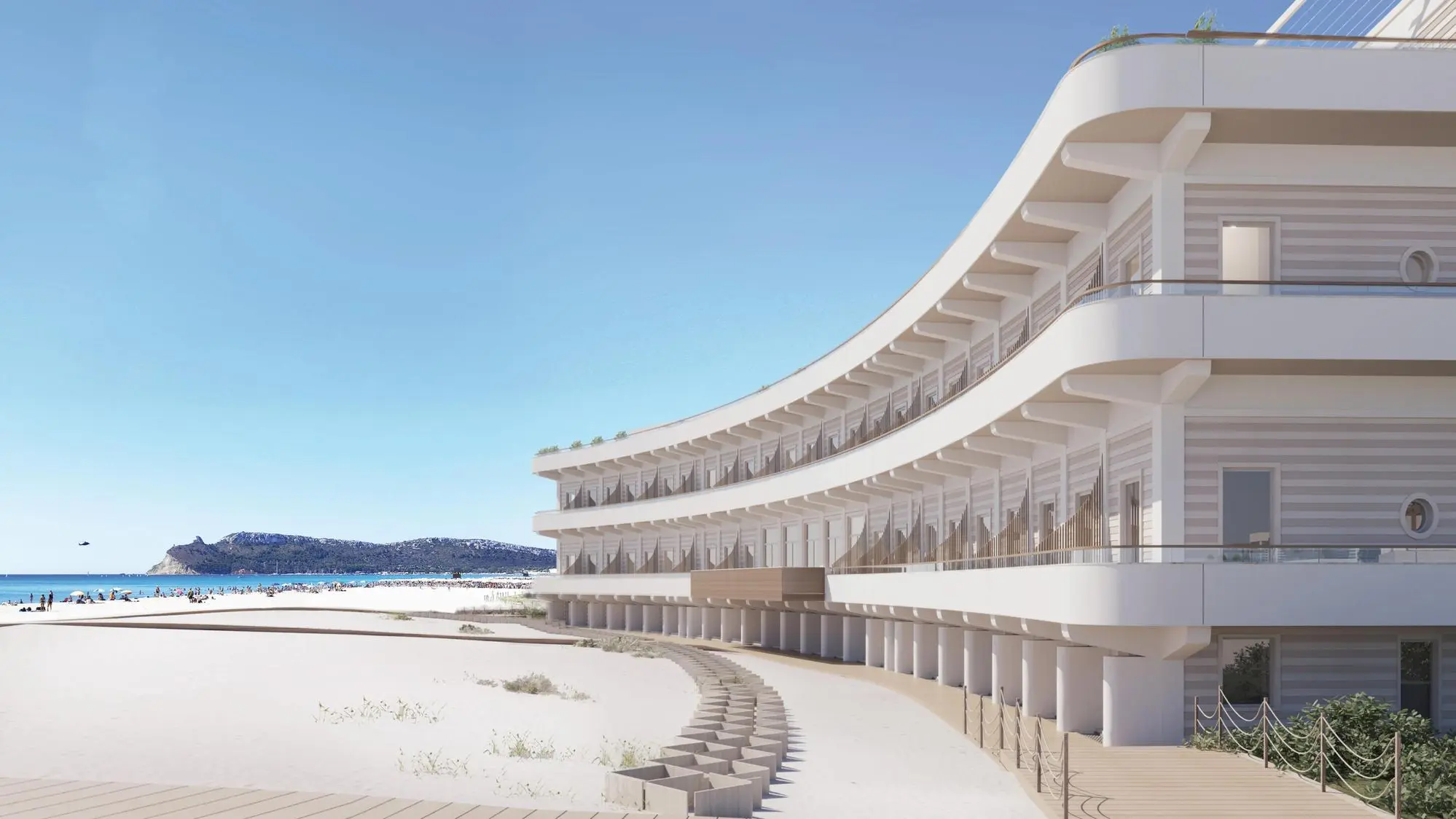


"It's not just a redevelopment project, but a civil and environmental rebirth project, capable of restoring life, beauty, and dignity to a place where decay and abandonment have prevailed for too long." Rosanna Laconi, Sardinia's Environment Councilor, on behalf of the Todde Regional Council, delivered the final administrative act for the old Marino Hospital in Cagliari, a "ruin" by the sea ready to "become a luxury hotel immersed in nature." The Region has completed the environmental assessment process. All that's missing is the City Council's acknowledgement.
The Project – At the eighth stop on Poetto, as the people of Cagliari call it, the former hospital will make way for 127 five-star beds, designed "according to criteria of minimal impact and full reversibility, with full respect for the delicate coastal ecosystem," as well as the "protected areas of Molentargius and the Saline. The goal," the councilor continues, "is to ensure a lasting balance between environmental protection, sustainable development, and historical memory." The resolution lists all the bodies that reviewed the project documents: from the Southern Sardinia Landscape Protection Service to the Regional Urban and Landscape Planning Department, as well as the Departmental Inspectorate of the Forestry Corps and the One-Stop Shop for Environmental Protection (SUAPE) of the Municipality of Cagliari. "A long administrative process that will allow Poetto to be restored to its status as a symbolic place for the city," bringing "one of its most emblematic buildings back to life," the Democratic Party member of the council emphasized.
From past to future – There's indeed a lot of history behind this €12 million redevelopment. A public tender in January 2021 established the rules and criteria for the revitalization: the winning bidder was Colonia Hotel srl, a company affiliated with entrepreneur Sergio Zuncheddu, publisher of the L'Unione Sarda Group. The dates help reconstruct the context: Sardinian politicians took over thirty years after the hospital's final closure to decide on the Marino's new future. It was the early 1980s when doctors and patients began to be moved to the former Esit building, a short distance away. The relocation of services and offices was completed in about a decade, leaving the two-story building vacant, which from aerial shots resembles a crescent moon on the beach. Its shape was designed by Cagliari architect Ubaldo Badas starting in 1937. It was the former Colonia Dux for children, where pride of place was reserved for poor and sickly children. Iodine, especially against tuberculosis. After the Second World War, it was converted into a hospital, providing seaside treatment for trauma and fractures. Then it was abandoned, punctuated only by a few sporadic insights. A long administrative paralysis was now behind it.








