









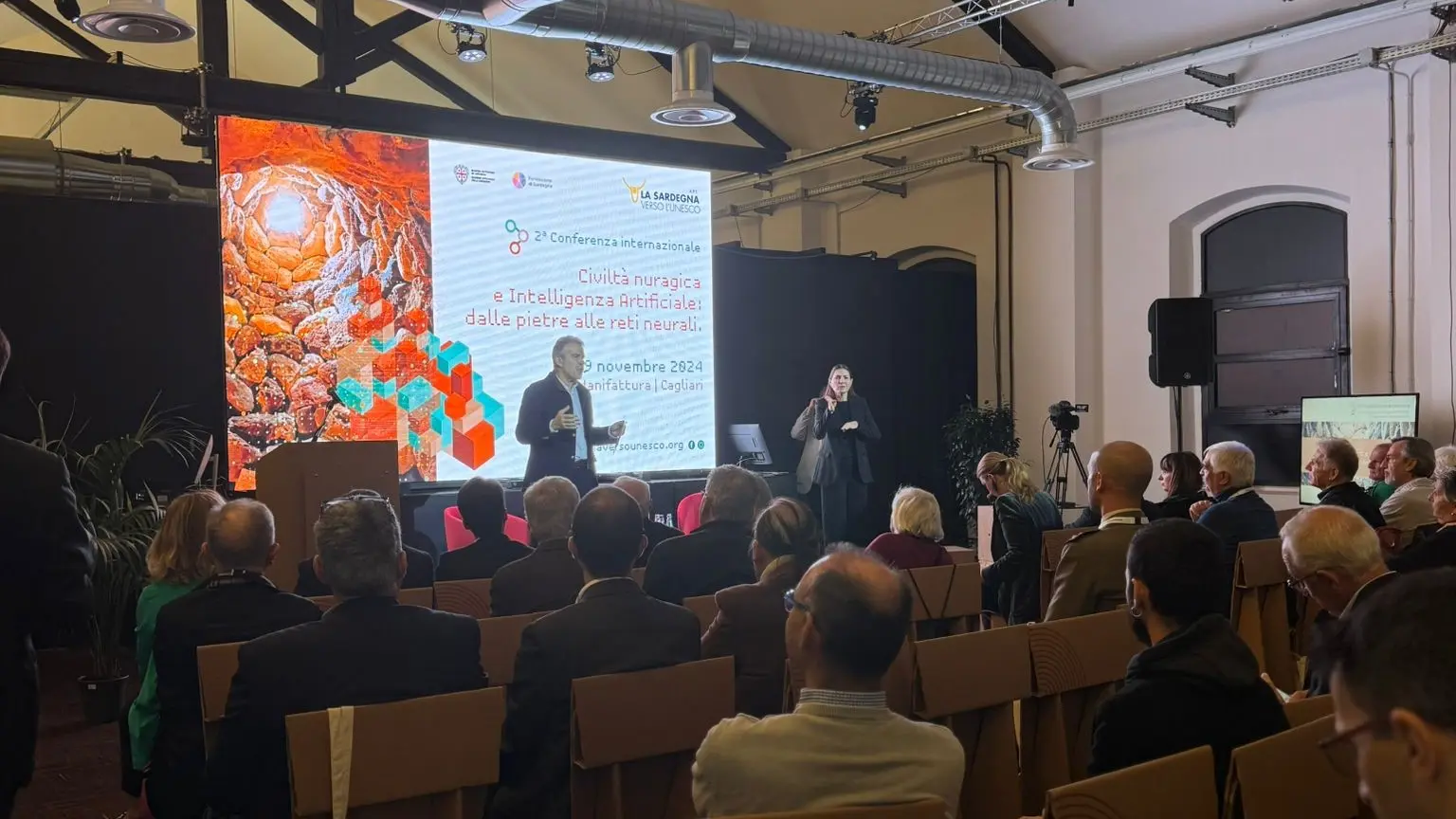


Over 200 people attended Sa Manifattura in Viale Regina Margherita in Cagliari for the international conference organized by "La Sardegna verso l'Unesco", entitled "Nuragic civilization and Artificial Intelligence: from stones to neural networks" and which saw the participation of experts from all over the world. Divided into two time and thematic windows, which captured the attention of participants until the evening, the initiative linked the project of valorization of the Nuragic civilization for Unesco purposes to new technologies , opening an interdisciplinary discussion that touched on numerous aspects of AI, also applied to the Nuragic civilization.
Opening the proceedings, after the institutional greetings, were Ivan Blecic and Massimo Deriu with the EIA project, Ecosystem for Innovation in Protohistoric Archaeology . “EIA” in its medium-long term vision aims at designing an international center for the enhancement of Nuragic monuments, while the closest objective will be to create a network composed of archaeological sites but also of all the subjects that manage them and put them into a system to offer management, enhancement and fruition tools.
Introduced and moderated by journalist and Rai presenter Barbara Carfagna, the first guests X-rayed the new frontiers related to artificial intelligence . Alberto Mattiello, business futurist and expert in technological innovation, allowed participants to better understand the infinite opportunities related to AI for those who deal with spreading culture and the possibility that today comes from new technologies to know worlds that do not exist by creating a storytelling around them. Gaming applied to culture was instead the topic discussed by David Gallo, CEO & Managing Director of ONE-O-ONE Games and 101%. And again: Google Cloud's AI technologies applied to different sectors with Salvatore Piazza, executive account manager of Google Cloud for the Local Public Sector market.
The current state and new perspectives related to culture in the afternoon interventions . The work started with an initial introduction of the scenario entrusted to Stefano Quintarelli, who allowed participants to understand how AI is actually everywhere, for example in any search on the internet (where it operates remotely on our smartphone, precisely showing the results it deems most suitable for us) and how the prospect of creating an artificial intelligence similar to human intelligence is not realistic today.








