











So they end up underground. There no one sees them, no one can control them. The conscience silenced by the blindfolded of a society that consumes and pollutes as if there was no tomorrow. It does not matter if poisons capable of devastating water tables and subsoil end up inside those huge "holes", nothing simpler than to pour any kind of waste into the heart of the earth, preferably dangerous. As if the deal concerned only those few gentlemen engaged in the most nauseating traffic, that of the most invasive waste of society.
Other than "circular"
Yet for years, decades now, rivers of ink have flowed on the circular economy, that of reuse, of a production that leaves no stone unturned to recover any residue that would otherwise pollute and devastate the environment. Everyone talks about it, there are even those who venture into primates as "recyclers". The reality, on the other hand, is quite another, sequenced by numbers that tell an opposite story. Calculations hidden in the maze of those who should scream and pursue them, rather than omitting them in the oblivion of indifference. If there is a land that has always been impregnated with the overwhelming essence of myrtle and juniper, with unique and Mediterranean scents par excellence, that is Sardinia.
Violent assault
The assault, on the other hand, right here, is violent, underground and in many ways supported. The primacy this time is carved in numbers to make you shiver, all enclosed in the algorithms of the Higher Institute for Environmental Protection, Ispra. The data are stacked by the thousands in Excel tables where everything appears complicated, as if it were only stuff for insiders. In that vortex of the latest report on waste published by Ispra, however, a reality emerges that could be silently perceived but for which there was no objective and irrefutable confirmation.
Cloaca of poisons
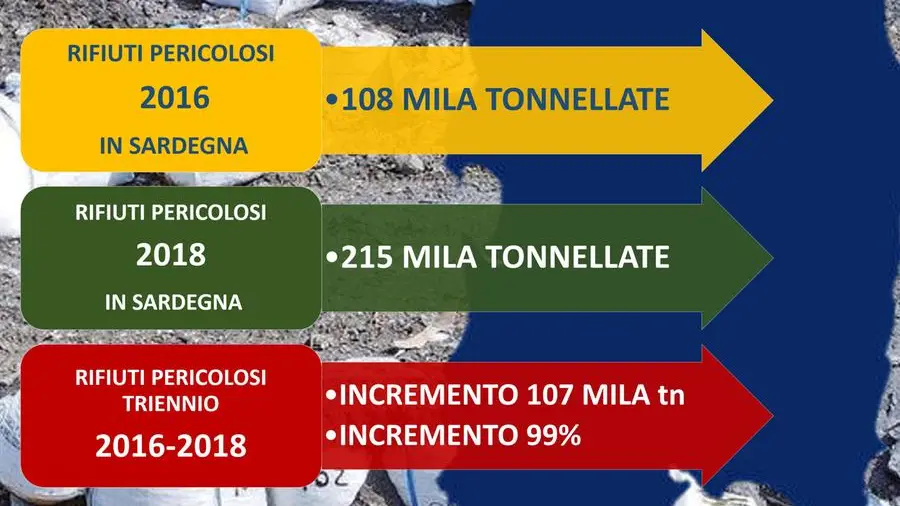
Let's start from the summary: in less than three years Sardinia has been transformed into a real national sewer of hazardous waste. Proportionally, the absolute number one in the disastrous ranking of hazardous waste stored on the island. What is most dramatic, however, is something to make one shudder: the land of the Nuraghi is by far the second largest Italian region for the absolute disposal of hazardous waste. The comparison with the first Region, however, does not hold up in the least. The ranking of hazardous waste thrown underground sees Lombardy, the most populous and industrialized region in Europe, at the head. Sardinia, on the other hand, is marked by one of the lowest European population densities, certainly one of the poorest, and with the lowest production impact in the country, on the other hand, is in second place. Lombardy, with over 10 million inhabitants, recorded, in the latest Ispra report on hazardous waste, a landfill of 288,000 tons of special hazardous waste.








