









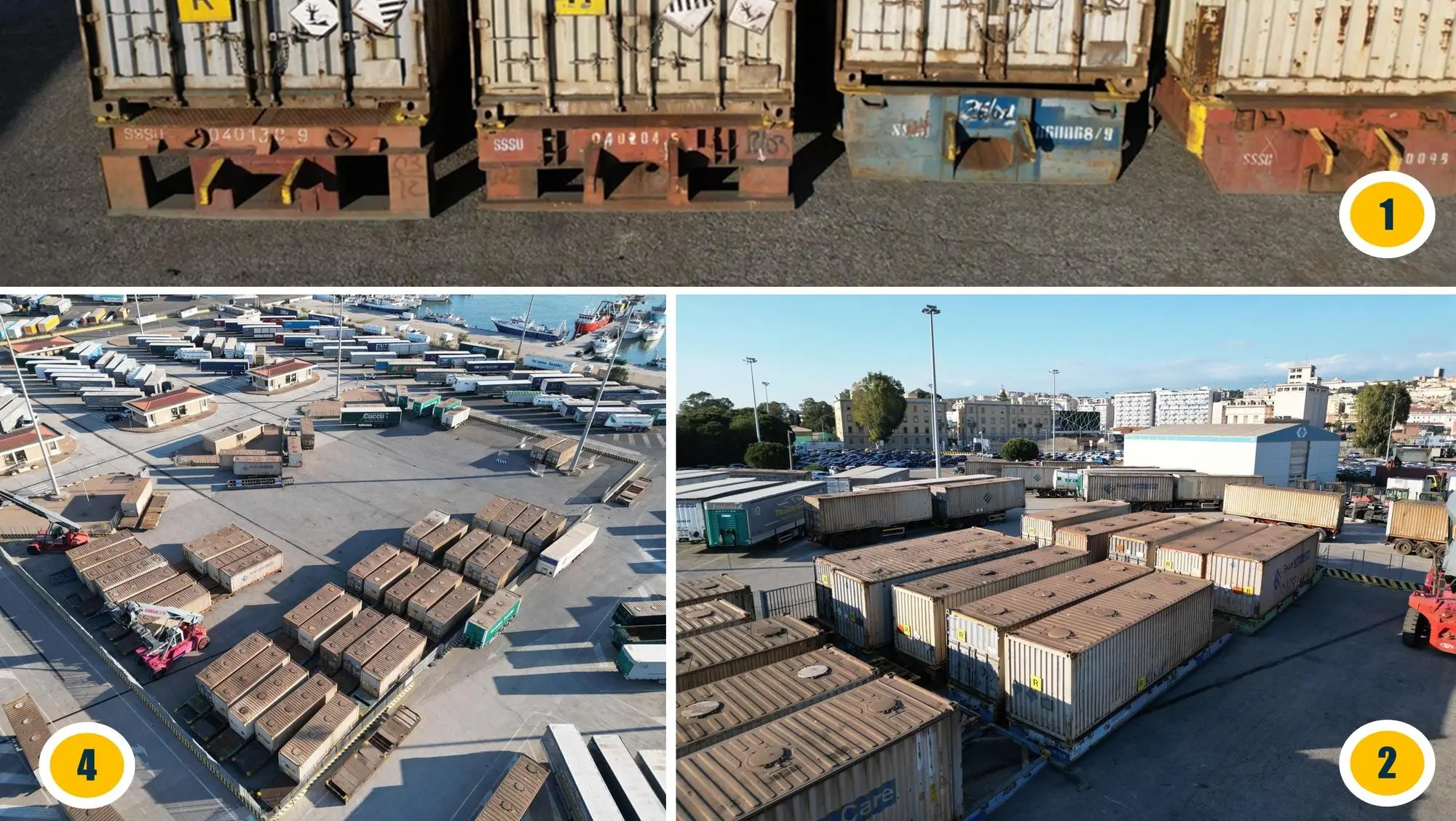


They arrived on the island like any other container. Sent into no man's land without any control, traveling along roads across half of Italy, crossing the Tyrrhenian Sea and landing with impunity in the land of Sardinia. It is late at night when one of the ferries moored at the Ponente pier of the commercial port of Cagliari opens its unloading door. The landing "tractors" are ready for the challenge of time, unloading as quickly as possible the infinite garages of those cargo ships full of everything and more.
“Heavy” hold
Those port workers in charge of the transition from the ship to the mainland are the first, without any protection, to enter the "hold" to attach those steel boxes with a capacity of 36,000 kg each. Those gray containers like death, here, in the customs outpost, have been known for years. Some have perceived the danger, others ignore it completely. The only code of recognition are those powders that pervade every crevice of that container that came from far away, sometimes from northern Italy, sometimes from abroad. The black “R” printed in large letters on a yellow background is the only recognizable banner: waste.
Poison dump
Everyone knows that they can't get to Sardinia, except for those "cursed" steelwork fumes, the scraps of scraps, all coming from the large steel producers who see the island as a "cure-all" for them and their budgets. , to dispose of, literally making those processing wastes full of every poison disappear. Between Friday night and Saturday morning, however, the alarm goes off. The radiometric unit reports an anomaly in a first container which even manages to arrive in Portovesme.
812 km unpunished
It had left two days earlier from Cremona, a steelworks in the Lombardy hinterland, in a contingent of twenty containers overloaded with industrial "dust", red alert waste, with a well-known destination: the Glencore plant, the global lead and zinc giant , which, after the divestment of the mining sector, had converted a large part of the plants, in the industrial heart of Sulcis, into a sort of landfill-incinerator for steelworks fumes coming from all latitudes. With all the risks and dangers, starting from the nuclear-radioactive ones. Delivery at all levels is that of silence, in the factory and above all in port. The order is that of confidential communications: Prefect, Mayor of Portoscuso, perhaps the Commissioner of the Municipality of Cagliari. There are certainties about the first two, but not about the third. The news arrives verbally to the mayor of Sulcis: there is a load of non-standard radioactive substances at the port of Cagliari.








