









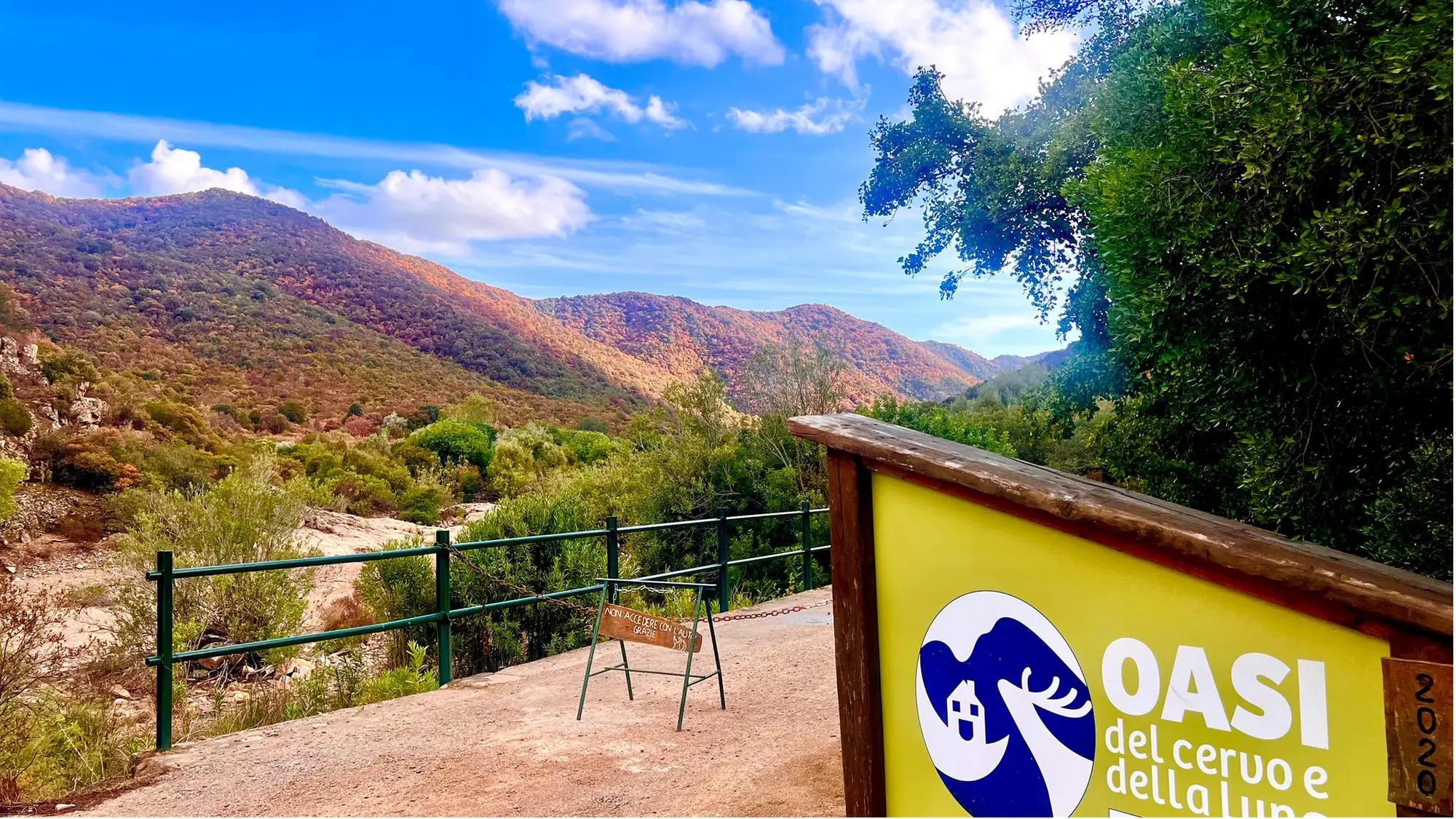


The wave is as long as a tsunami. Disruptive and disproportionate, almost as if nothing could stop that scar that advances inexorably in the forests of the Island. From the Heels of Ogliastra to the Oasis of Cervo, deep south of the land of Sardinia. Crossing the borders of Monte Arcosu, between an esplanade of unpunished American photovoltaic panels and never healed mountain wounds of the last disastrous flood that hit Capoterra and its surroundings, is like passing the checkpoint of an inviolable treasure chest. The gaze on the impetuous green, mitigated only by the rays of the morning sun, here, on the slopes is only a memory.
Slow heartbeats
That beating heart of holm oaks and cork oaks, junipers and cistus, mastic and myrtle, wild olive and rosemary, has slowed its beats. The strawberry tree that insinuated itself halfway up the hill is struggling. Those four thousand hectares of Sardinian forest, a unique mix of varieties forged from granite soil, are the cradle of the Sardinian deer, first on the verge of extinction and now the dominant species on this stage. The "dark evil", the deadly cocktail of drought and pathogenic fungi, has crossed the border of the south of the island. It has insinuated itself like lightning at the gates of the capital, when the gaze was entirely turned towards the spread of the phenomenon on the hinterland of the eastern coast. The horizon, seen from Castello, on the front of the "Bastione" of Buon Cammino, leaves no hope.
Red spot
The red stain is indelible in the skyline towards Capoterra, Uta and Assemini. The green hues have marked the pace of that eloquent march of that pathogenic agent that is already upsetting hundreds of thousands of hectares. When the view gets closer, along the Macchiareddu-Capoterra, towards the hinterland, you understand that it is not an optical illusion. From the entrance door of what has always been the home of the deer, you realize that those red stains are endless, across the main gorge of the WWF refuge. The watercourse that wedges itself into the lowest level curve is still marked by the upheaval of the flood catastrophe of 2008. The debris pushed from upstream to downstream has created stone dams, which still obstruct the natural riverbed. The concrete road crossings, built to ford the river, have since then been overturned, turned upside down by the force of the wave that hit the Rio San Girolamo. Now that path is only wet, for a few drops that have broken in recent days on those slopes, without ever reaching the dignity of a glass of water. For the rest, however, that disaster visible to the naked eye cannot be just perennial drought, also because you can glimpse spots that are still green and lush, surrounded, however, by infinite expanses inexorably marked by that evil that is breaking the forest resistance of half of Sardinia. Attempts to downgrade to a cyclical phenomenon what everyone can see with the naked eye are useless: on the ground no one has any memory of such devastation, still without a complete and precise explanation, as if the evil had suddenly fallen from the sky. It is no coincidence that the applied research, called Life-Fagesos Project, started in 2022 and concluded in 2027, includes several European regions that overlook the Mediterranean, but not the Sardinian Region. However, the University of Sassari is part of the monitoring plan, which has included Monte Arcosu among the areas to be monitored. A study that today becomes damned premonitory of what is virulently manifesting from north to south of the Island: «Phytophthora-induced decline of fagaceae ecosystems in southern Europe exacerbated by climate change: preserving ecosystem services through better integrated parasite management». It is no coincidence that the international project had an explicit objective: «Address and remedy one of the most serious threats associated with global climate change: the outbreak of alien invasive plant pathogens, which negatively impact natural and semi-natural forest ecosystems».








