









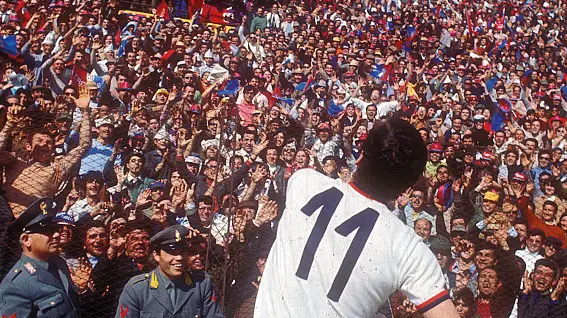


The Treccani Italian Encyclopedia celebrates Gigi Riva. The story of one of Italy's greatest footballers is told in a volume in the "Italian Myths" series, which retraces his life story and sporting achievements, revealing the complexity of a national legend.
Born on November 7, 1944, in Leggiuno (Varese), and died in Cagliari on January 22, 2024, Luigi Riva, a brilliant header, shot almost exclusively with his left foot. However, with it, whether on the volley, from a standing position, or with acrobatics, he scored goals that have gone down in Italian football history. Sports journalist Gianni Brera nicknamed him "Thunderbolt" to emphasize his devastating attacking ability.
But it wasn't just his exploits on the field that made Riva a legend. As Carlo Maria Ossola, president of the Treccani Italian Encyclopedia Institute, observes in the book's introduction: "Gigi Riva was celebrated beyond the power of his shot: he became an idol for his tenacious attachment to Cagliari (he, of Lombard origin, was never seduced by lucrative transfer offers from continental teams), which touched the most secret vein of all belonging: loyalty. Loyalty to a vocation, not a profession; in an interview in Monaco in 2005, he declared: 'I would have paid to play football, and they paid me.' This is the whole charm of Gigi Riva's story: his unwavering loyalty to a vocation, to a region, to a dream. This is why his legend remains intact within us."
The book develops on two levels: on the one hand, the popular hero, the footballer—a symbol of redemption for Sardinia and a national icon—on the other, the reserved man, marked by family bereavements, injuries, and a lifestyle choice far from the mainstream.
Curator Giorgio Pitzianti traces the emotional journey of an initially peaceful childhood in his hometown of Leggiuno, later marked by early bereavements that would become the foundation of his identity. This led to the need to transform his pain into competitive energy, which was unleashed in Sardinia, where he arrived at nineteen and became not only a champion, but the cornerstone of a collective project.








