

The military parade is over. The warships, those that for twenty days occupied the coasts of Sardinia, from Quirra to Capo Teulada, passing through Poetto and Pula, retreated when the advance of the night had already made the Port of Cagliari deserted. The caravans of amphibious and armored vehicles, coming by land from the Teulada polygon, had crossed the Scafa bridge when the sunset had already settled on the Santa Gilla salt pans. The change of strategy, from the relentless invasion of the last few weeks, bursts into the evening lights when the blue flashing lights accompanying the long columns take the square of Luna Rossa, in the square of Molo Ichnusa. All vehicles end up directly in the courtyard of the Navy, behind that iron and brick fence that has always occupied the largest seafront in Cagliari. All closed inside the state compound, away from prying eyes. We have to wait for the amphibious ships to cross the Molo di Levante late at night to moor for cargo right on the quay that was the most famous Italian “vessel” in the land of sailing and regattas. Loading into flagships has never been so quick.
The silence of the night
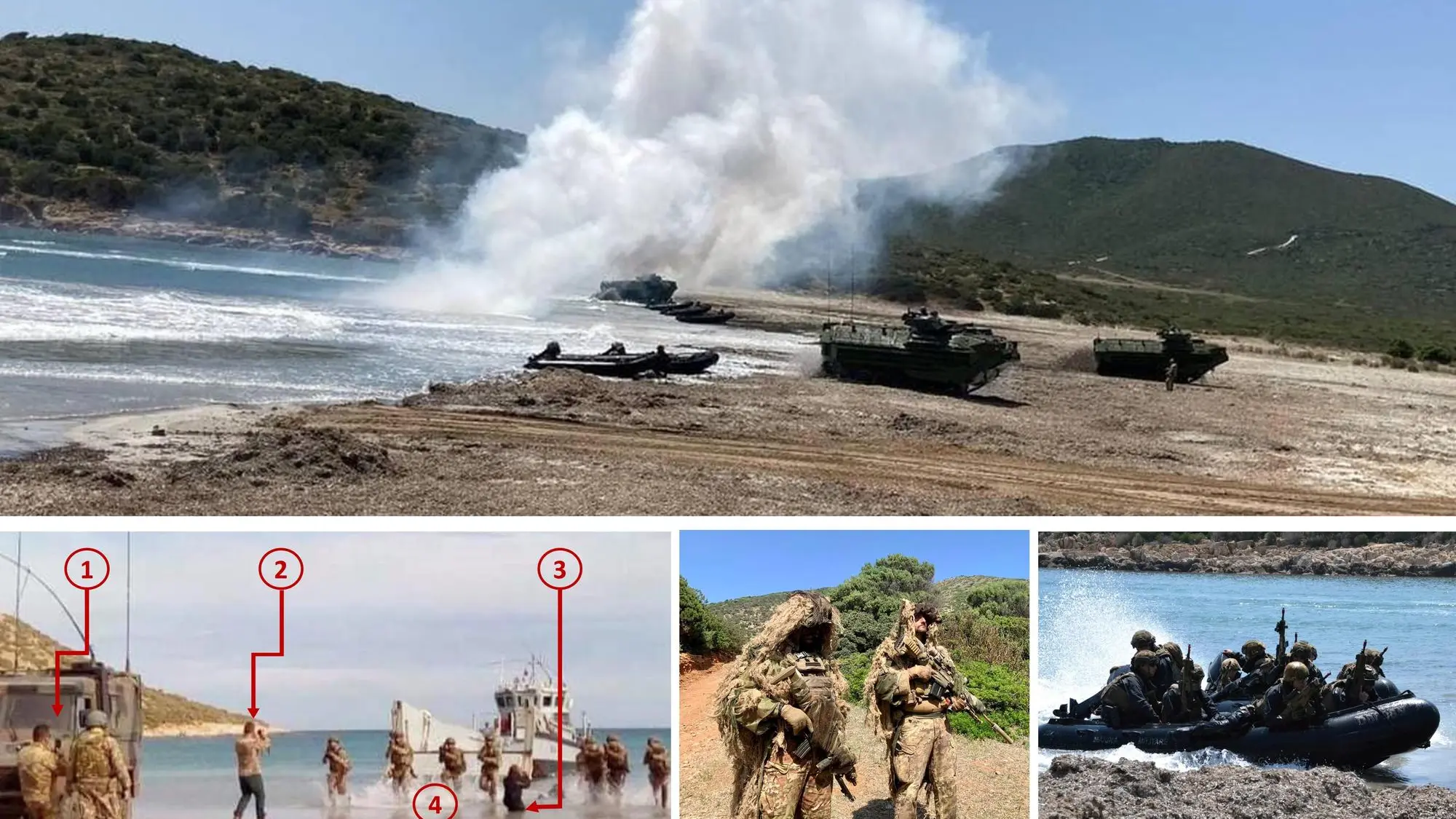
We must avoid that the images of war burst again on social networks with the disappointment that becomes indignant in the presence of the daily war radiated over the air. When dawn is already high, the loading operations are completed and the flagships have taken off. For the moment, the prohibitions at sea, with the exception of the seized beaches "in aeternum" of Teulada and Quirra, give way, until the next invasion. In the memory remain the images, the environmental devastation, the occupation without a "why" of infinite water spaces in front of the most exclusive beaches and, above all, that Sardinia transformed as never before into a sensitive target. There are American and Italian aircraft carriers, Spanish ones and German warships, all lined up on the paradisiacal proscenium of the turquoise waters of the Nuraghi Island. And then there are the "four" photographers, those of State, authorized and ready to immortalize the "bloody" scenes of the landing in "Normandy" on the enchanted and segregated beaches of Porto Scudo and Cala Zafferano, to be destroyed as if the "Created" in the land of Sardinia it was illegal. It is no longer even necessary to subtract from the Defense archives those frames of such violence in the presence of the white beaches of the south of the island. Those amphibious assault “poses” are the proven proof of the military script to be exhibited for use and consumption of out-of-time muscular evidence nailed in the annals of history. And, in fact, in Teulada's “military set” there are almost more photographers than men in camouflage.