

Here, in what was supposed to be the port of central Sardinia, the tracks are reduced to a tangle of rust embalmed by time. Those horizontal bars placed like iron snakes between the access roads of this industrial port mark the decline of an ascent that never happened. The proscenium is dotted with gigantic sheds occupied by birds and rubble. The mistral, at dawn on Sinis, even lashes out that scent of freshly baked rusks from the large pasta factory overlooking the Gulf of Oristano, the only symbol of an entirely local production. For the rest, it's all a contradiction. There is the bunker, there are the gigantic tanks of oil, diesel, petrol and even the gas cylinders.
The wind power landing
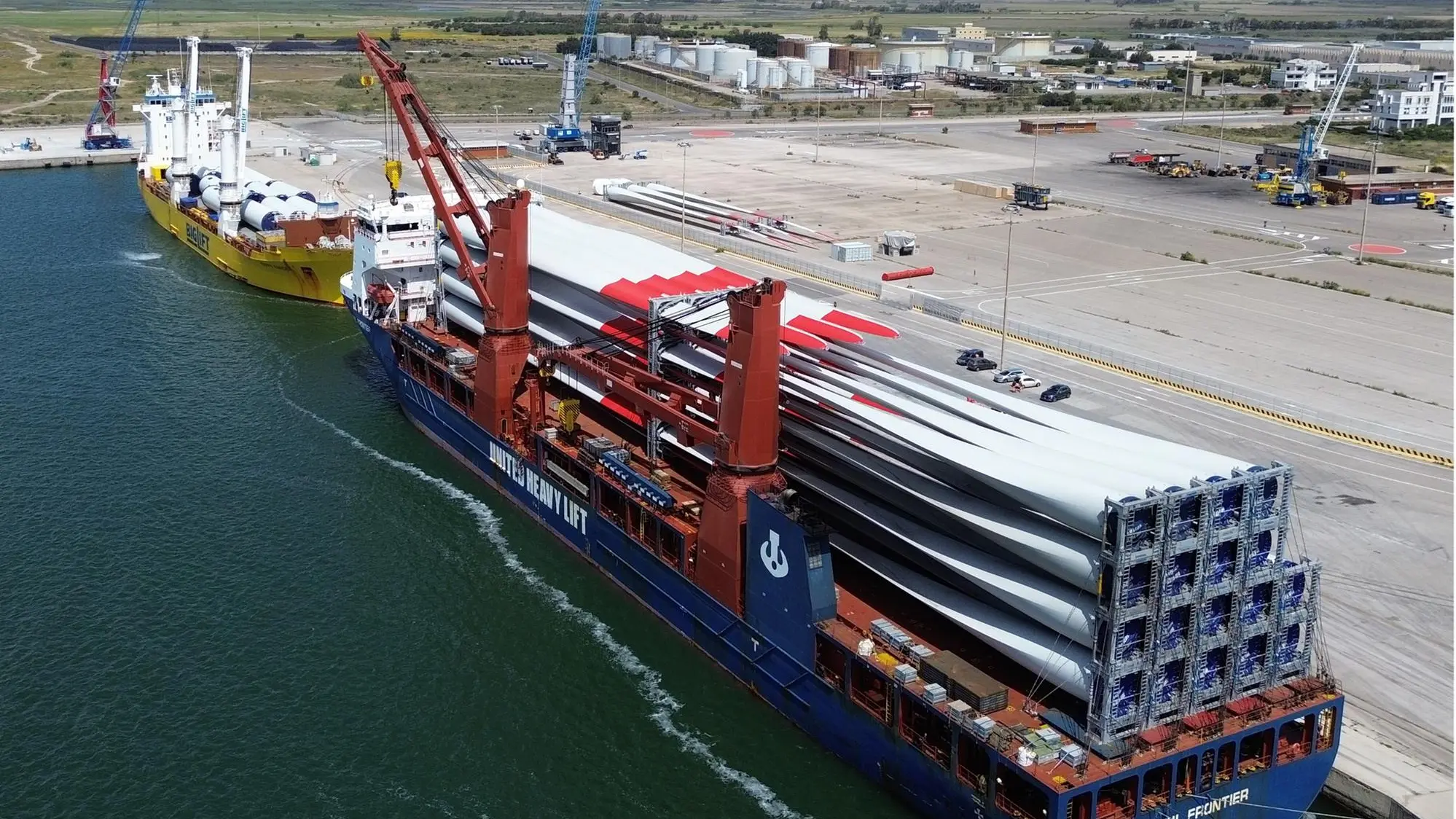
When the “ Uhl Frontier ”, a very special cargo ship flying the Portuguese flag, is about to dock on the horizon of the dock of that deserted port, few people know what it is carrying. The "giant" of the seas sailed the western Mediterranean for days, after setting sail from " Puerto de la Luz ", a dependance of the Canary Islands , between Santa Cruz de Tenerife and Fuerteventura . The wind blows cold and low, when the " United Heavy Left " livery is clearly cutting the mistral, crossing the entrance gate of the industrial port of Oristano. As soon as the bow appears on the dock you can tell from a mile away that the wind invasion is about to land in the heart of Sardinia. The chosen port is the furthest and most discreet, silent and circumspect, marginal and away from prying eyes.
War drums
Yet, when the "vessel" hooks the bollards, the tom tom is a war drum. The image leaves one astonished at the mere thought of a landing destined to multiply by a hundred, by a thousand, until not even a ridge of the island is left untouched, forever disfiguring the nuragic landscape of the oldest island in the Mediterranean. In recent days the first shovels had arrived, unloaded in the square, without leaving fingerprints. Yesterday, however, the first wind-powered ship "suffered" the glory of the " ", immortalized far and wide as a symbol of that invasion that has always been denounced, but not yet materialized with the dramatic landing from the sea. It doesn't take long for the port of "Sartiglia" to make its second docking of the morning. The wind's sister company, the motor ship " , flying the Dutch flag, arrives shortly after, carrying on board the pylons that will have to support those cyclopean propellers stowed in the first ship dedicated to the "Day of Landscape Devastation" of the Land of Sardinia. The alarm messages flow in the chats of the committees, with some " " trying to "belittle" the docking with justifications that lead to ridicule, from the thesis that they are "spare parts" or that they are propellers just passing through the port of Oristano. The thirty-six blades lying on top of each other in the ship's hold obviously cannot be spare parts, given that their dimensions do not fit well with existing systems. If anything, that load can be allocated to so-called " " operations designed by the Draghi Government with imperial acts to replace small-sized wind turbines with real "dinosaurs" of the sky, the latest generation wind turbines branded "Vestas", capable of a power that goes from 3 to 6.8 megawatts. "Skyscrapers" 70 floors high to be placed in the middle of the most exposed ridges of the island, as if to delimit the new boundaries of the multinationals ready to take over the landscape and environment without firing a shot. Now that the ships are in port, geolocated, however, it will be difficult to lose their traces, both of the "wind" load and of the comings and goings that they are preparing to consume right on the western side of Sardinia, confirming what we had announced in recent months, revealing the plans of numerous multinationals intending to base themselves close to ancient , the gulf favored for "enemy" landings. It remains to be understood who gave the authorization to transform that port infrastructure into a real platform for the wind invasion of Sardinia, given that the yards have already been occupied for weeks by wind turbines arriving who knows when. Certainly in recent days the delegate in Sardinia of the American investment bank JP Morgan had announced, in a public meeting with the municipal administration of Pula, that Oristano would also be their support platform for transporting the wind turbines destined to the 300 meter "offshore skyscrapers" in the Gulf of Angels, going so far as to explain that the transport would all take place "cost to cost", without "disturbing" traffic.